Why Vinyl Will Not Stick, by Surface
Wood, glass, plastic and painted surfaces each fail for a different reason, and the fix for one makes another worse.
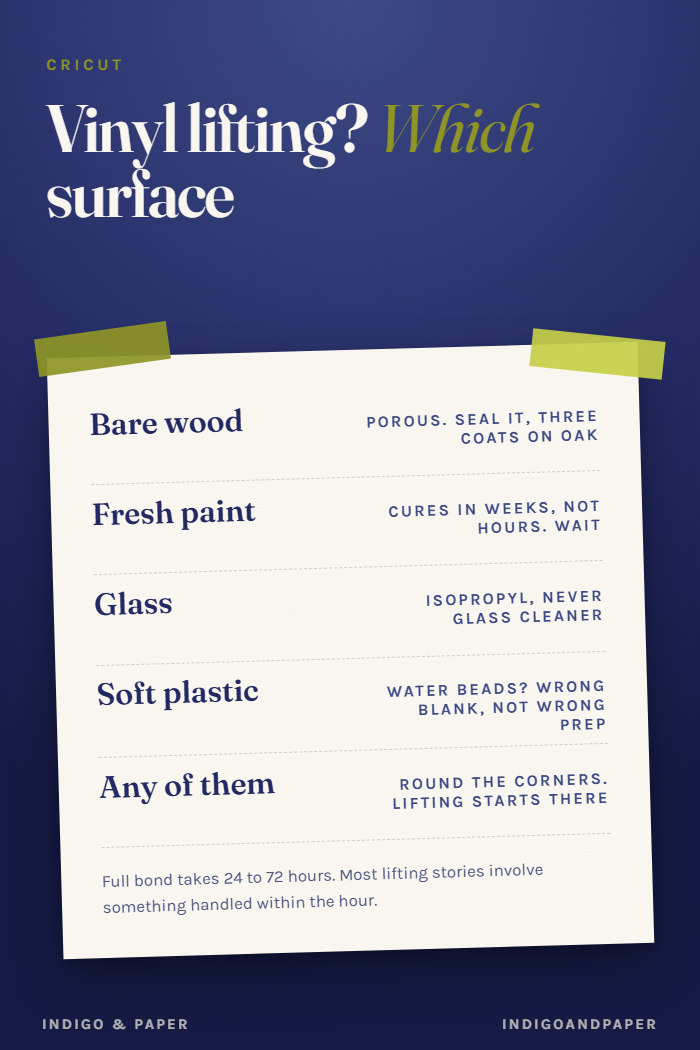
Vinyl that lifts is almost never bad vinyl. It is a surface the adhesive was never going to hold, and which surface you have decides the fix — the thing that rescues a coat of paint will ruin glass.
Find your surface.
Bare or stained wood
Wood is porous and textured, and adhesive needs a continuous flat surface to grip. On raw timber it makes contact with the high points of the grain and nothing else, so the decal is held by a fraction of its own area.
The fix is to stop it being wood. Seal it — two coats of clear polycrylic or a matte sealer, sanded lightly between — and apply to the sealed layer. On open-grained timber like oak or ash you will need three.
Applying vinyl to raw wood and then sealing over the top is the common shortcut. It works for a while, and it fails by lifting at the edges where the sealer could not bridge the step.
Painted surfaces
Two different failures wear the same face here.
The paint has not finished curing. Latex and emulsion are touch-dry in hours and fully cured in two to four weeks. Vinyl applied to uncured paint sits on a surface that is still off-gassing and still soft, and it will lift — or worse, bond and then take the paint with it when removed. If the paint is less than a fortnight old, wait.
The paint is satin or eggshell with additives. Some formulations are deliberately low-adhesion. Nothing you do to the vinyl will change that; test a small piece in a corner before committing.
Glass and glazed ceramic
The opposite problem. Glass is perfectly smooth, so contact is not the issue — contamination is. Glass carries oils from handling and residue from whatever cleaned it last, and glass cleaner is the usual culprit: most contain additives that leave a film specifically designed to repel water, and they repel adhesive just as effectively.
Clean with isopropyl alcohol, not glass cleaner, and do not touch the area afterwards. Let it flash off completely — a minute — before applying.
Plastic
The hard one, because "plastic" is several materials.
Polypropylene and polyethylene — most food containers, many toy surfaces, some tumblers — have low surface energy. Adhesive does not fail to reach them; it fails to wet them, the way water beads on a waxed car. Standard craft vinyl will not hold on these regardless of preparation.
If a drop of water beads up rather than spreading, that is the material you have, and the honest answer is a different blank or a different adhesive.
Acrylic, PET and polycarbonate are fine, and want the isopropyl treatment as for glass.
Powder-coated and textured metal
Powder coat is usually fine. Texture is the problem — a hammered or crackle finish gives the same reduced contact area as raw wood, and there is no sealing step available.
Small decals survive on texture; large ones lift from the middle outward. If the surface has visible relief, size down.
The two things that are true everywhere
Pressure, then time. Adhesive is pressure-sensitive: it needs firm pressure across the whole decal, not just a rub over the middle. Then it needs to be left alone. Most craft vinyl reaches full bond strength in 24 to 72 hours, and almost every "it lifted" story involves something being handled, washed or posted within the hour.
Round the corners. Sharp corners are where lifting starts, because they concentrate every stress the decal will ever meet into one point. Rounding them by a millimetre or two costs nothing in the design and is the single most effective change to how long a decal survives handling.
If it came off the mat badly in the first place
Then adhesion is the second problem, not the first. A cut that did not go cleanly through leaves edges that were already compromised — six causes and how to tell them apart from the edge the blade left.
And if the shape fell apart rather than lifting, that is a weld problem with its own three signatures.