Why Your Cricut Isn't Cutting All the Way Through
Six causes, in the order worth checking, and how to tell which one you have from the edge the blade left.
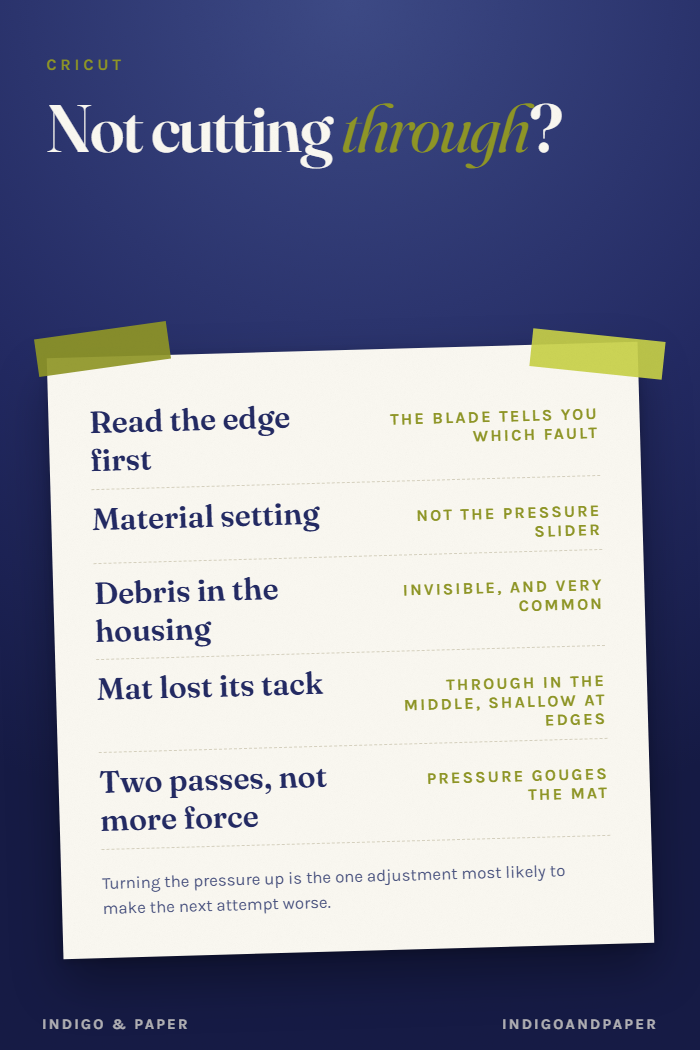
The machine ran, the mat came out, and the vinyl will not weed. Almost everybody's first move is to raise the pressure, and that is the one adjustment most likely to make the next attempt worse.
Work through these in order. The order matters — it is cheapest-and-most-likely first, and each step tells you something about the next.
Read the edge before you change anything
Peel one shape and look at what the blade actually did. The edge is the diagnosis:
- A faint scored line, no separation — not enough pressure reaching the
- material. Causes 1, 2 or 3.
- Cut through in places, missed in others — inconsistent contact. Mat or
- material flatness. Cause 4.
- Cut through the backing as well — too much pressure, and the fix is the
- opposite of what you were about to do.
- Ragged, furry edges — a dull or chipped blade. Cause 3.
- Clean cut, but tears when weeded — not a cutting problem at all. Skip to
- the last section.
1. The material setting, not the pressure
The dial or the material list is doing more than the pressure slider. "Vinyl" and "premium vinyl" are different settings, and glitter, holographic and matte of the same brand often are too, because the carrier thickness differs.
If you chose the closest-looking option rather than the exact one, that is the fault about half the time. Set it correctly before touching anything else.
2. The blade housing has debris in it
Small offcuts collect inside the housing and stop the blade seating fully. It is invisible from outside and it is extremely common.
Pull the blade out of the housing, press the plunger, and look at what falls out. Most people find a surprising amount of material the first time. This costs thirty seconds and fixes more failed cuts than any setting change.
3. The blade is dull, or it is the wrong blade
Blades are consumable. A fine-point blade that has cut a lot of cardstock or any glitter vinyl will be blunt well before it looks blunt.
Cardstock, chipboard and felt want a deep-point or knife blade, not fine-point. Running heavy material on a fine-point blade dulls it quickly and cuts badly while doing so, which is two problems developing at once.
4. The mat is not holding the material flat
A mat that has lost its tack lets material lift a fraction of a millimetre under the blade, and the cut becomes intermittent — through in the middle of the sheet, shallow at the edges.
Press the material down with a brayer or the flat of your hand across the whole sheet, not just the corners. If the mat no longer holds a sheet of copy paper by one corner, wash it or replace it.
5. Multiple passes, before more pressure
If it is still shallow, add a second pass at the same pressure rather than raising the pressure on one.
Two passes at the correct pressure cut cleanly. One pass at excessive pressure cuts the backing, gouges the mat, dulls the blade and distorts small detail — which is why "just turn it up" tends to produce a worse result and a new problem to diagnose next week.
6. The design itself is too fine
Below a certain stroke width the material cannot survive being cut, regardless of the machine. Thin script tails and small serifs come away with the weeding even when the blade did its job perfectly.
That is a font problem rather than a machine problem, and it is diagnosable before you cut: three properties decide whether a script font survives the mat, and all three are visible in the specimen image.
When the cut was fine and it still tore
If the edge is clean and the shape still comes apart during weeding, the cut was not the failure. It is usually one of the three weld problems, and each leaves a different signature in the vinyl.
---
If you check fonts before buying rather than after cutting, the three checks are on paper in the Font Weld Test, with a scoring sheet for comparing candidates. $9.