Why Iron-On Vinyl Peels Off, and Which Variable to Change
Four variables make an HTV bond, and only one of them is heat. Most failed transfers are a pressure problem being treated as a temperature problem.
Heat transfer vinyl does not glue itself to fabric. It has an adhesive layer that melts, flows into the weave, and then sets as it cools. That is the whole mechanism, and every failure is one of its four inputs going wrong.
The four are heat, pressure, time and the fabric itself. Almost everyone who has a peeling transfer reaches for the first one, and it is usually the second.
Read the failure first
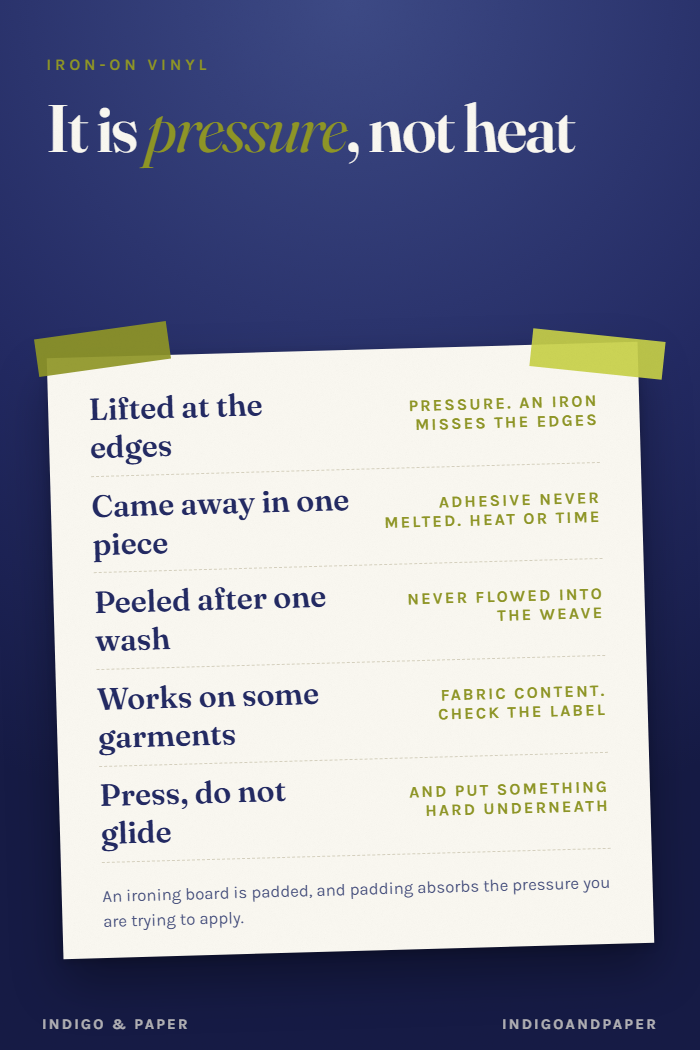
It lifted at the edges, centre still down — pressure. The middle of a household iron gets contact; the edges of a design do not.
It came away in one piece, cleanly — the adhesive never melted, or never had time to. Heat or time.
It stuck, then peeled after the first wash — it bonded to the surface fibres but did not flow into the weave. Almost always pressure or time.
It will not stick to one garment but works on others — fabric content. Skip to that section.
It looks shiny, stiff or scorched — too much of everything. Rare, and the only case where turning something down is the fix.
Pressure is the variable people skip
HTV needs firm, even pressure — the kind you have to lean on. Not the weight of the iron.
Two things go wrong with a household iron. It has steam holes, so pressure is absent in patches across the plate. And it is small, so a design wider than the soleplate never gets pressed at all in places.
If you are using an iron:
- Steam off, and empty the reservoir. Moisture works against the adhesive.
- Press, do not glide. Ironing motion is wrong. Put it down, lean, hold,
- lift, move to the next section with an overlap.
- Work in sections and count each one separately.
- Put something hard underneath. An ironing board is padded, and padding
- absorbs exactly the pressure you are trying to apply. A wooden board or a
- worktop with a towel over it is better.
Time, and the part that happens after
Whatever your material's instructions say, count it rather than estimating. Pressing "for a bit" is how a transfer gets six seconds when it needed fifteen.
Then read the carrier sheet instruction, because peeling at the wrong moment undoes correct work:
- Cold peel means fully cold. Not warm. Peeling a cold-peel material while
- warm lifts the design straight back off.
- Warm or hot peel means promptly, while the adhesive is still soft.
If a corner starts lifting as you peel, stop, lay it back down and press that section again. Once it has been peeled badly it will not re-bond as well, so it is worth catching in the first centimetre.
Fabric decides whether it can work at all
Cotton and cotton-rich blends are the easy case.
Polyester and performance fabrics need lower temperatures — they scorch and glaze — and they want an HTV rated for them. Standard HTV on a sports top is a common and unfixable failure.
Waterproof or coated fabrics, and anything with a stain-resistant finish, are actively adhesive-hostile. That finish exists to stop things sticking, and it succeeds.
Heavy texture — canvas bags, ribbed knits, towelling — reduces contact area the same way raw wood does for adhesive vinyl. Press longer, press harder, and expect large solid areas to do better than fine detail.
Check the garment label before blaming the vinyl. It is the fastest diagnosis available and it is free.
Prewash, without softener
New garments carry manufacturing residues, and fabric softener leaves a coating designed to make fibres slippery — which is the opposite of what an adhesive needs. Wash, no softener, no dryer sheets.
The two-second check before you press
Lint-roll the area, and give it a short press on its own to drive out moisture and flatten the weave before laying the design down. Both take seconds and both remove a whole category of failure.
If the design fell apart before it got near the fabric
Then this was never an adhesion problem. Fine strokes lifting during weeding is a design-and-cut issue — three properties decide whether a script survives the mat, and a cut that did not go cleanly through has its own six causes.
---
The three weld checks are on paper in the Font Weld Test, with a scoring sheet for comparing candidates before you buy. $9.