How to Price What You Make
The formula is not the hard part. Putting your own time in it is, and that is the line almost everyone leaves out.
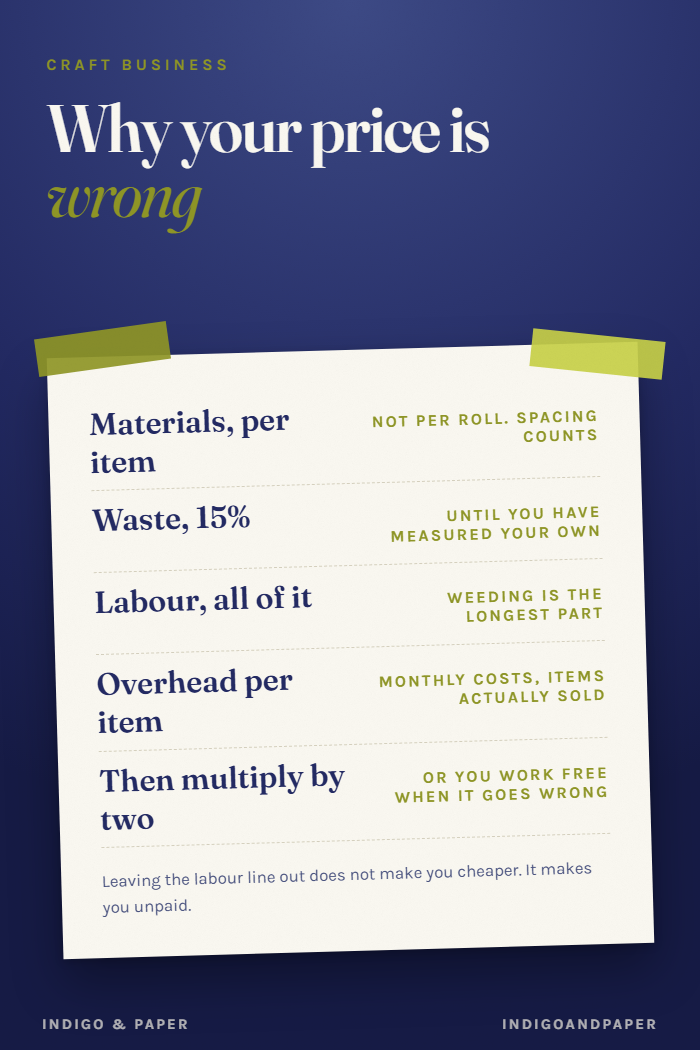
Almost every underpriced handmade product is underpriced the same way. Not by guessing badly — by leaving one line out of the arithmetic, always the same line, and then wondering why a busy month produced no money.
The line is your time.
The formula, which is not the interesting part
(Materials + Labour + Overhead) × 2 = your price
You can find that in a hundred places. It is correct, and reading it changes nothing, because the difficulty was never the multiplication. It is that three of those four terms are hard to look at honestly.
Here is what each one actually contains.
Materials means everything the customer takes away
The vinyl, obviously. Also the transfer tape, the blank, the thread, the glue, the backing card, the cello bag, the sticker that seals it, the box, and the label.
And then waste. Every cut leaves offcuts and every batch has a failure. Fifteen per cent is a reasonable placeholder until you have measured your own, and measuring it is a weekend of writing down what you binned.
Cost per item, not per roll. This is the arithmetic in reverse and it is why a 30cm offcut feels free when it is not: divide what the roll cost by how many finished items the roll actually yields, spacing included. Three millimetres between shapes across a full mat is more material than it sounds.
Labour means all of it, at a real rate
Not "the twenty minutes it took to press". All of it:
- designing the file, or adapting the one you bought
- machine time you cannot walk away from
- weeding, which everybody forgets and which is the longest part
- pressing, assembly, quality-checking the ones that failed
- photographing, listing, writing the description
- answering three messages about postage
- packing, and the trip to the post office
Then multiply by an hourly rate you would accept from an employer. Not a "getting started" rate. If you would not take £8 an hour from a stranger, do not take it from yourself — a business that only works while you are underpaid is not a business yet, it is a subsidy you are paying.
This is the line people leave out, and leaving it out does not make you cheaper. It makes you unpaid.
Overhead means the costs that exist whether or not you sell
Machine, blades, mats, the software subscription, the font licence, the listing fees, the payment fees, the domain, the packaging you buy in bulk.
Add the monthly total, divide by the number of items you actually sell in a month. Not the number you hope to. If you sell thirty things and your fixed costs are £90, that is £3 on every item before you have touched a material.
Most people discover here that they are running at a loss on their cheapest product line and subsidising it with the expensive one.
Why multiply by two
The multiplier is the part that sounds like greed and is not. It covers:
- the order that arrives damaged and gets remade at your cost
- the customer who wants three changes
- the twenty enquiries that never buy
- the listing that sat unsold for a year and eventually sold at a discount
- tax
- and, eventually, profit — the thing that is left after you have been paid
- for your time, which is a different thing from your wage
At ×1 you are working for nothing the first time anything goes wrong. At ×2 you have a business that survives ordinary friction.
Wholesale is not "the price minus a bit"
If a shop asks for wholesale, the convention is half your retail price, and the arithmetic only works if your retail price was right to begin with.
Which is the real reason to get this correct even if you only sell direct: a retail price built on unpaid labour cannot be halved. If somebody offers you a wholesale order and the maths collapses, the wholesale order is not the problem.
The craft-fair adjustment
A stall has costs a listing does not: the pitch fee, the fuel, the day itself. Add the pitch fee divided by the number of items you realistically sell that day, and count the whole day as labour, not just the making.
The honest version of a craft fair is often that it pays for itself and buys you a mailing list. That is a legitimate reason to do one. "It made money" is usually not the reason, and the sheet will tell you which you had.
When the number frightens you
It usually will, the first time. Three responses, in order of how often they are right:
- Check the labour line. If the number is absurd, it is almost always
- because the item takes far longer than you believed. That is worth knowing:
- the answer may be to change the product, not the price.
- Change what you make, not what you charge. Some products cannot carry a
- fair price. Discovering that is the sheet doing its job.
- Charge it anyway. People underestimate how much of their competition is
- also underpriced and quietly exiting. Being the one who is still trading in
- two years is worth more than being the cheapest this month.
What you should not do is drop your rate. That is the one adjustment that feels like a business decision and is not.
The thing this does not cover
Whether you are allowed to sell it at all. Pricing a mug you cannot legally put that font on is an expensive way to be organised — four questions settle almost every real case, and they are worth asking before the order, not after.
---
If you would rather fill this in than rebuild it each time, we have made the worksheet — pricing, licence record, material yield, and what you actually banked. It is not on sale yet; it goes up shortly, and the pricing sheet will not give you a number until the labour line is filled in, which is the whole point of it.