How Much to Charge for Cricut Shirts, Worked Out From Your Own Costs
For heat-transfer vinyl shirts the blank is the biggest material cost, a misprint costs the whole shirt, and every extra colour adds a round of weeding and pressing.
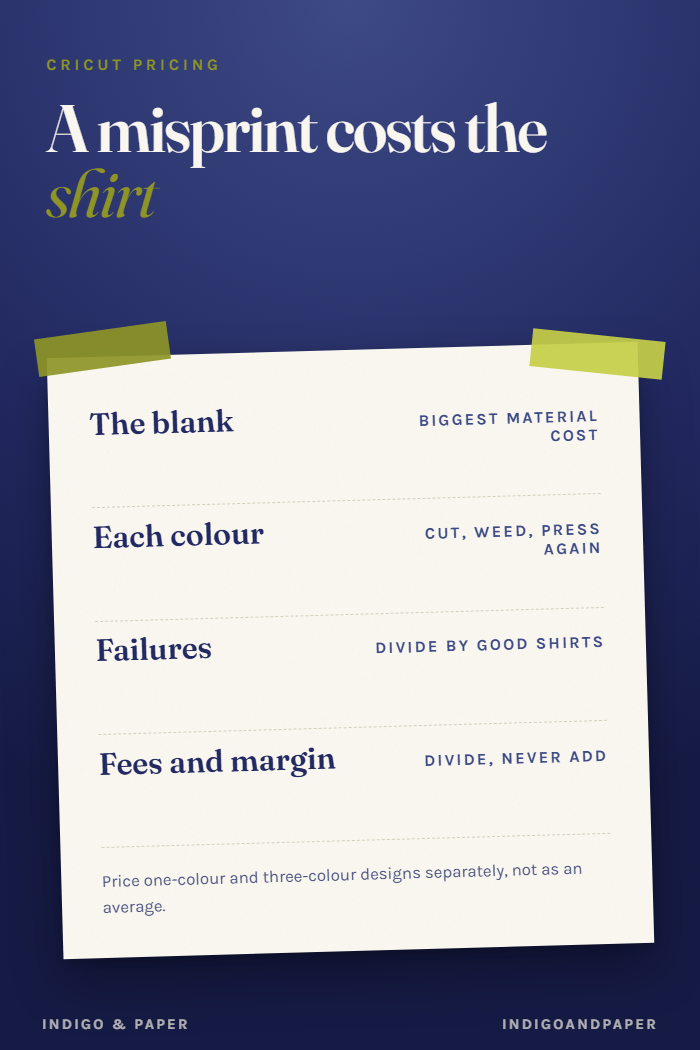
A vinyl shirt is priced the same way as any other handmade item: materials, failures, time, overhead, then fees and a margin you chose. What changes is where the money sits. On a shirt, the blank is usually the biggest material cost, a mistake costs you the whole garment, and each colour you add brings its own round of cutting, weeding and pressing.
The general method is in how to price what you make, and decals have their own version. This is the shirt one.
Materials: the blank first
Everything below uses invented numbers, to show the arithmetic.
The blank. Say $4.50 a shirt, bought in a pack. Price the size you are actually selling. Larger sizes often cost more, and one price for every size means the big ones subsidise nothing.
The vinyl. Work it out per square inch, with the weeding margin around the design included. A roll that costs $15.00 and is 12 by 60 inches gives 720 square inches, about 2 cents each. A design that uses 30 square inches is about $0.63 of heat-transfer vinyl.
Everything else that leaves with it. A mailer, a thank-you card, a tag. Say $0.40.
Materials: $4.50 + $0.63 + $0.40 = $5.53.
Misprints cost the shirt, not just the vinyl
A crooked transfer, a scorch mark, or a layer that shifts on the second press does not lose you 63 cents of vinyl. It loses you the blank too. Count your real failure rate over a few batches. If one shirt in twelve is unsellable, the eleven good ones carry its cost: $5.53 becomes about $6.03 per sellable shirt.
Time, including every layer
Time a real order from start to finish:
- design, spread over the copies you expect to sell of it
- cutting, then weeding, per colour
- pressing each layer, with the peel and any re-press
- folding, packing and labelling
A one-colour design and a three-colour design are different products, because each extra colour repeats the cutting, weeding and pressing. Price them separately rather than averaging.
In the example, fifteen minutes at $18 an hour is $4.50.
Overhead, fees and your margin
The heat press, mats, blades, the teflon sheet and the software all wear out or renew whether or not orders arrive. Spread them per shirt. Say $0.50.
Cost per shirt: $6.03 + $4.50 + $0.50 = $11.03.
Marketplace and payment fees are a percentage of the price, so divide rather than add. With an illustrative 8% in fees and a 30% margin:
$11.03 ÷ (1 − 0.08 − 0.30) = $11.03 ÷ 0.62 ≈ $17.79
That is the floor for this example, not a price to copy. Your blanks, timings, failure rate and fees will produce your own number, and shipping and discounts move it again.
Custom orders
A customer's own design, name or date is a new product every time: design time is not spread over future copies, and a proof round adds more. Quote custom work from the time it takes, and say in the quote what a change after approval costs.
If you want the arithmetic done for you
Paper or any spreadsheet will do, once you have timed a real order.
The Maker's Pricing Workbook is a spreadsheet laid out in this order. Its Batch costs tab has twelve material rows, room for the blank, vinyl and packaging, plus six labour rows and six overhead rows, all divided by the shirts you can actually sell. Its Price tab takes fees, shipping, discounts and your own target margin, with a status line when the price you chose misses it. It has been opened and recalculated in Microsoft Excel for Windows. Google Sheets and Excel for Mac have not been tested. It will not tell you what to charge. $6.99.