Cricut Mats — Which One, and How to Get the Tack Back
Four grips, and using the wrong one is why your cardstock shifts or your vinyl tears. Plus what actually restores a mat, and what quietly ruins it.
A mat has one job: hold the material still, then let it go without damage. Both halves matter, and most mat problems are one of them being optimised at the expense of the other.
The four grips, and what each is actually for
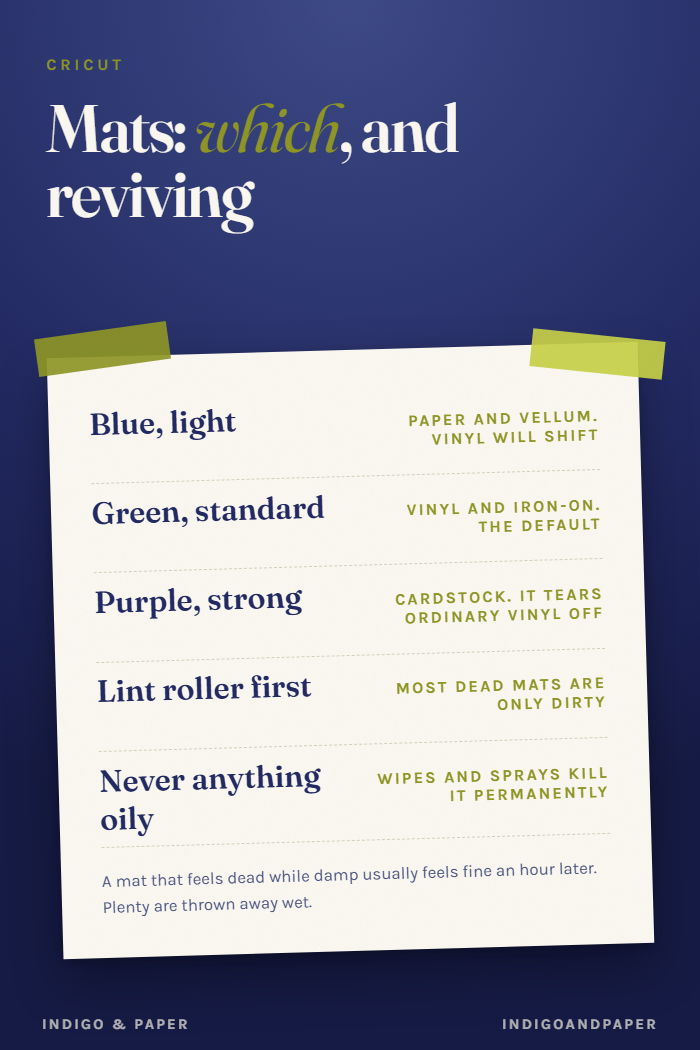
Light grip (blue) — printer paper, thin card, vellum. Anything that tears when you lift it. Too weak for vinyl, which will shift mid-cut.
Standard grip (green) — the default, and correct for most vinyl, iron-on and patterned paper. If you own one mat, this is it.
Strong grip (purple) — thick cardstock, chipboard, leather, magnet sheet. Genuinely aggressive. Putting ordinary vinyl on it is the usual cause of "my vinyl tore when I took it off": the mat won.
Fabric (pink) — bonded fabric and felt, and it is not a stronger green. The surface is different, and cutting vinyl on it wastes the mat.
The two failures are symmetrical. Too little grip and the material shifts mid-cut, producing shapes that are subtly wrong rather than obviously wrong — a shifted mat is often diagnosed as a blade problem. Too much grip and the material tears on removal, or curls as you fight it off.
Getting the tack back
Mats lose grip to fibres, dust and skin oils long before the adhesive itself wears out. Most "dead" mats are dirty rather than finished.
In order of how much you should try first:
- A lint roller or the sticky side of tape. Removes the loose layer.
- Thirty seconds, and it recovers a surprising number of mats.
- Warm water, a drop of dish soap, and a soft brush or plastic scraper.
- Work in circles, rinse thoroughly, then let it air-dry completely — flat,
- sticky side up. Do not towel it dry; the towel donates fibres to the
- surface you just cleaned.
- **Isopropyl alcohol on the *edges only***, where the mat gets handled most.
Time matters more than technique. A mat that feels dead while damp usually feels fine an hour later, and plenty are thrown away wet.
What ruins a mat
Anything oily. Baby wipes, household surface sprays, and any cleaner with a moisturiser or a shine agent leave a film that permanently repels adhesive. This is the commonest way a mat is destroyed while being rescued.
Scrubbing hard, or a metal scraper. Scratches hold dirt and never grip again.
Heat. Do not leave a mat in a hot car or near a radiator. It will warp, and a warped mat feeds unevenly, which produces exactly the intermittent cut depth people blame on the blade.
Storing it uncovered. The clear sheet it came with is not packaging. Keep it, and put the mat away flat rather than propped against something.
When a mat is genuinely finished
Replace it when the surface is visibly scored across the working area, when it has a permanent curl, or when a clean mat still will not hold a sheet of copy paper by one corner.
Everything before that is cleaning.
Too sticky is also a problem
A brand-new strong-grip mat will destroy delicate material. Take the edge off deliberately: press a clean cotton t-shirt onto the surface once or twice, or stick and peel your palm across it a few times. You are removing a controlled amount of tack, so do less than you think and test.
If the cut was shallow rather than the material shifting
Then the mat may not be the cause at all. Shallow-but-consistent is usually a setting, a blade or debris in the housing — six causes in the order worth checking.
A mat problem tends to look like inconsistency: cut through in the middle of the sheet, shallow toward an edge, or shapes very slightly out of position.