Cardstock Weight, and Why "lb" Tells You Almost Nothing
The pound number on the packet is ambiguous by design. Gsm is not, and four bands cover almost every decision you will make.
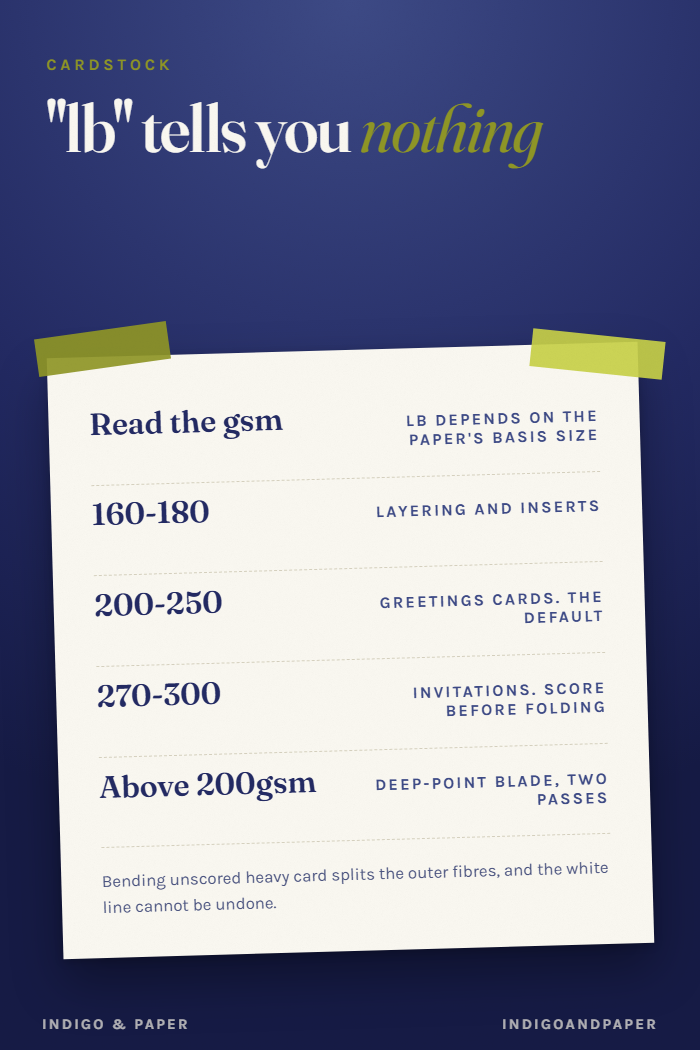
Cardstock is sold in two units and only one of them means anything on its own.
Gsm is grams per square metre. One sheet, one square metre, weighed. It is directly comparable between any two papers in the world.
Lb is not. A pound figure describes the weight of a ream of the paper at that paper's own basis size — and basis size differs by paper type. So 80lb text and 80lb cover are substantially different papers, and 110lb index is different again. The number is meaningful within a category and misleading across them, which is exactly how it gets used.
If a packet gives you both, read the gsm. If it gives you only pounds, find out which basis it means before comparing it to anything.
Four bands, and what each one is for
Approximate, because manufacturers vary, but these are the useful boundaries:
Around 160–180gsm — light card. Layering, inserts, backing sheets, anything that needs to be stiffer than paper without being a card in itself. Scores and folds cleanly with no preparation. Most home printers handle it.
Around 200–250gsm — standard cardstock. The default for greetings cards and most craft cutting. Holds a fold, stands up on a mantelpiece, and goes through most machines without argument. If one weight lives in your cupboard, this is it.
Around 270–300gsm — heavy. Wedding invitations, business cards, anything meant to feel considered. Needs scoring before folding — fold it unscored and the outer fibres crack in a visible white line. Many home printers will refuse it or jam.
Above 300gsm — very heavy and specialist. Beautiful, expensive, and it will not go through a standard printer or fold without proper scoring. Buy it knowing you are hand-finishing.
What it means for cutting
Weight changes three things on a cutting machine, and only the first is obvious.
The blade. Above roughly 200gsm a fine-point blade is the wrong tool. Deep point exists for this, and running heavy card on a fine-point blade both cuts badly and blunts the blade while doing it.
The number of passes. Two passes at correct pressure beat one at excessive pressure — heavy card is the case where this matters most, because the pressure needed to cut it in one pass will also gouge the mat and distort small detail. The full order for a cut that will not go through applies here.
The mat. Heavy card wants strong grip, and strong grip plus a delicate design tears on removal. Which mat, and how to take the tack off is the other half of this.
Intricate designs and heavy card fight each other. If a design has fine strokes, dropping to 200gsm often gives a better result than staying at 300 and turning everything up.
Texture is a separate axis
A 250gsm linen or laid card behaves differently from a 250gsm smooth one at the same weight: texture reduces contact area with the mat, and it gives a blade more edge to wander along.
Heavier is not the same as better here. A smooth 250 cuts more crisply than a heavily textured 300, and looks less special doing it.
If it is going in the post
Weight buys survival, but only up to the point where it starts costing postage. Thin card creases along the fold until the crease becomes a tear; very heavy card pushes an envelope into the next postal band.
Which paper weights actually survive the post covers the envelope side of that, which has a different answer from the card inside it.
The one thing worth remembering
Score before folding, above about 250gsm. Not because of a rule, but because of what the fibres do: bending unscored heavy card stretches the outer surface until it splits, and the white line that appears cannot be undone. It is the single most common way a nice piece of card is spoiled at the last step.