Four Questions to Ask About a Font Licence Before You Sell Anything
"Free for personal use" and "commercial licence included" are not the two ends of a spectrum. Here is what actually determines whether you can sell the mug.
Font licensing is where craft businesses quietly accumulate risk, because the rules are boring, the enforcement is rare, and the marketing language is designed to make you stop reading.
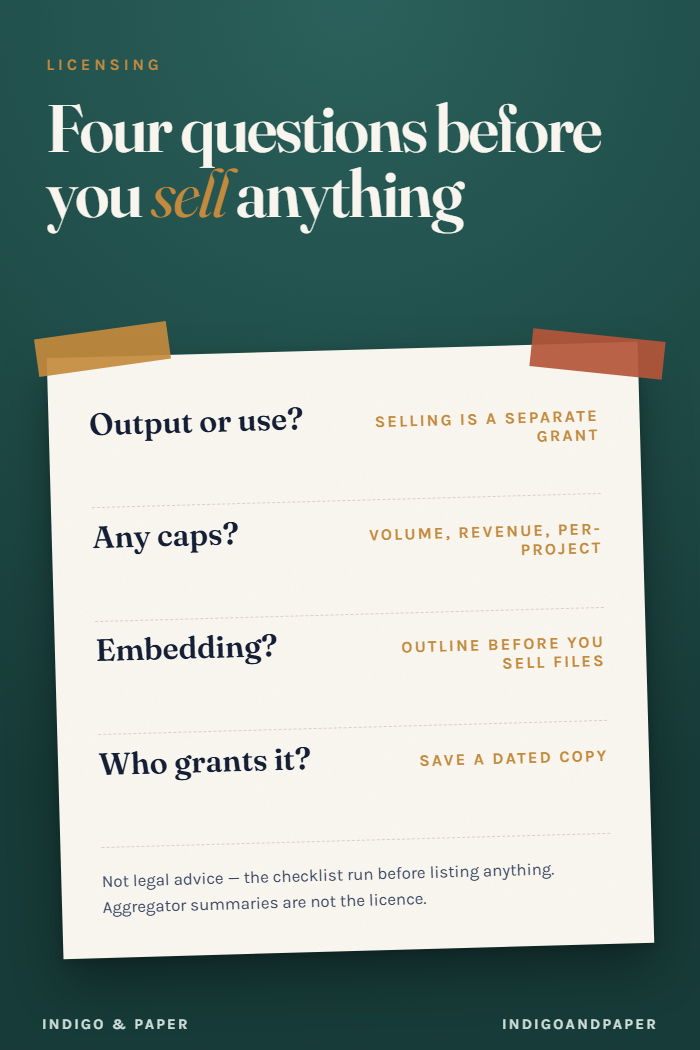
Four questions settle almost every real case. Ask them before you list a product, not after.
1. Does the licence cover selling the output, or only using the font?
These are different permissions and the distinction is the whole subject.
Most free fonts grant you the right to install and use the font. That is not the right to sell physical goods bearing the letterforms. A licence that says "free for personal use" means precisely that: you may make the sign for your own kitchen and may not sell it.
What you are looking for is language about commercial use or end products. If the licence never mentions selling, assume it does not permit it, because the default position of copyright law is that the rights holder keeps what they have not granted.
2. Is there a volume cap or a revenue cap?
Plenty of commercial licences are commercial up to a point. Common forms:
- a limit on the number of end products you may produce or sell
- a revenue threshold above which you need an extended licence
- a per-project or per-title licence rather than a perpetual one
None of these is unreasonable and all of them are easy to breach without noticing, because you breach them by succeeding. The one that catches crafters is the unit cap — five hundred sounds like a lot until a design does well.
3. Does it permit embedding, and does that matter to you?
Embedding is the font travelling inside a file you hand to someone else — a PDF, an SVG, an editable template, a Canva design.
If you sell physical goods, this rarely matters: the letterforms have become vinyl, and the font file never leaves your machine.
If you sell digital files — cut files, printables, editable templates — it matters enormously, and it is the single most common licensing failure in the digital-product side of this trade. Selling an SVG with live text in it distributes the font. Selling an SVG whose text has been converted to outlines usually does not, and "usually" is doing real work in that sentence: some licences restrict outlined redistribution too, particularly for fonts whose entire commercial value is the letterform.
The practical rule: convert text to outlines or paths before you sell any digital file, and read the licence anyway.
4. Who is granting it, and can you still see it in a year?
Keep a copy of the licence, dated, with the font.
Marketplace terms change, sellers withdraw fonts, and free-font sites relicense without notice. If a dispute ever arises, "the site said it was free for commercial use" is not an answer; a saved copy of the licence as it stood on the day you downloaded it is.
This takes about fifteen seconds per font and it is the highest-value fifteen seconds in this article.
The specific traps
"Free for commercial use" on an aggregator site. Aggregators mirror fonts and frequently misstate the licence. The designer's own terms govern, not the directory's summary.
Fonts bundled into a design you bought. Buying a template does not license its fonts to you for other work.
Dingbat and icon "fonts". Often licensed as artwork rather than as type, with stricter terms than the text fonts sitting next to them.
"Personal use" defined narrowly. A few licences treat a gift as commercial use if the recipient is a business, or treat anything posted publicly as distribution. Rare, but it exists.
Why subscriptions simplify this
The reason a lot of people doing this commercially end up on a subscription is not price. It is that the licence question gets answered once, in one place, in consistent language, rather than font by font across a dozen different designers' terms.
That is worth something specific: it removes the fourth question entirely, because the terms sit with the account rather than with each download.
Creative Fabrica's subscription is the one I use, and its commercial-licence position is stated at the account level. Read it yourself rather than taking my summary — that is the entire point of this article — but read one set of terms rather than forty.
One honest caveat
I am not a lawyer and this is not legal advice. It is the checklist I run before listing something, assembled from reading a lot of licences. If you are about to build a product line on a single typeface, the licence is worth an hour and possibly worth a professional opinion.