How to Journal Without Quitting in Three Weeks
Most journals are abandoned in the first month, and for a reason that has nothing to do with willpower. Here is what actually keeps one going.
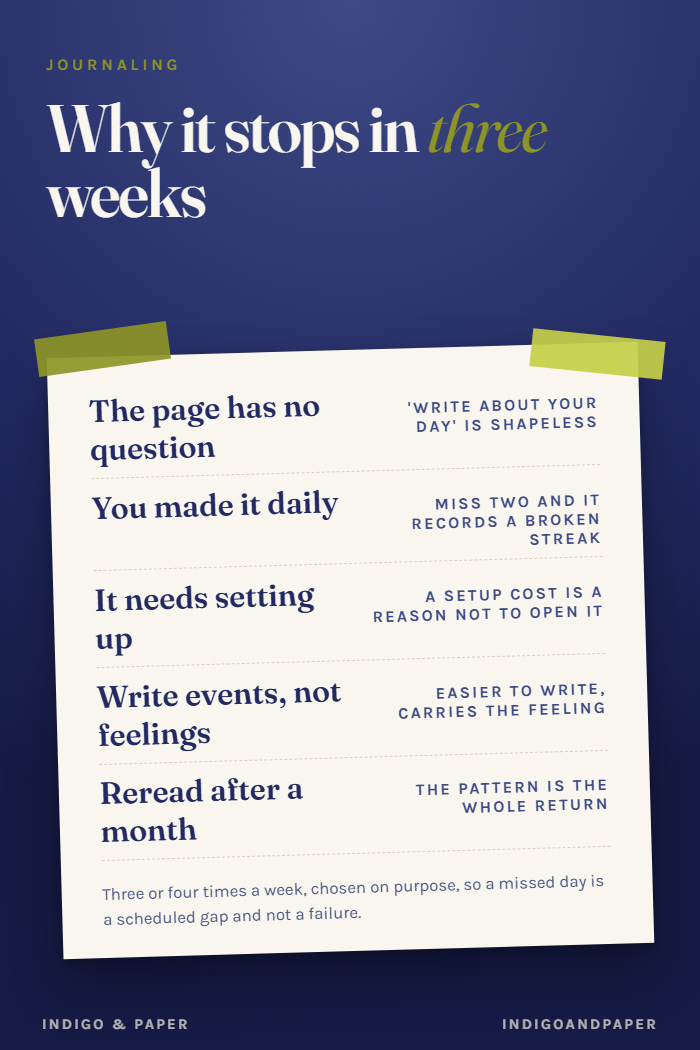
Most journals are abandoned inside a month. Not because the writer lacked discipline — because of three specific, avoidable things about how the practice was set up.
This is about the practice: how to keep one going and what to put on the page when nothing comes. It is not about journaling as therapy. That is a real subject and a different one, and it is not ours.
Why they get abandoned
The empty page has no question on it. "Write about your day" is an enormous, shapeless instruction. Faced with it most people write a weather report, notice it was dull, and open the book less often. The problem is the prompt, not the writer.
It was set up to be daily. Daily is the commonest choice and the worst one. Miss two days and the book becomes a record of a broken streak, and the third day is when most people quietly stop. Anything you do a few times a week survives a bad fortnight; anything daily does not.
It was made beautiful before it was made useful. A journal that needs a ruler, three pens and a layout is a journal with a setup cost, and a spread that requires preparation is a spread that stops being prepared.
Start with a question, not a blank page
The single most effective change: never sit down to "write". Sit down to answer something.
Four that reliably produce writing, because each has an actual answer:
- What happened today that I did not expect? Filters out the routine
- automatically.
- What am I avoiding? Uncomfortable, and the most productive of the four.
- What did I change my mind about? Rare, so it makes the entry worth
- rereading years later.
- What took longer than I thought? Dull-sounding, quietly the most useful,
- and after a month it will have taught you something concrete about how you
- actually spend time.
Rotate them. Answer one. Three sentences is a complete entry.
Write about what happened, not how you feel — at least at first
Feelings are hard to write and hard to reread. Events are easy to write and carry the feeling anyway.
"I was anxious all afternoon" tells you very little in six months. "Rewrote the same email four times and then did not send it" tells you everything, including the anxiety, and it is far easier to put on paper.
Concrete beats introspective, particularly early on when the habit is fragile.
Three or four times a week, deliberately
Choose a frequency below what you think you can manage, and choose it on purpose so that a missed day is not a failure but a scheduled gap.
If you want a record of whether you did it, use something that cannot look like failure — a standard tracker grid fails around day nine for a structural reason, and marking additively removes it.
Date every entry, and nothing else
Skip the elaborate headers. A date is what makes an entry findable and placeable in five years, and it is the only piece of structure that reliably earns its ink.
Reread after a month, on purpose
This is the step almost nobody takes, and it is where the value actually is.
An entry is worth little the day it is written. A month of entries read together shows the pattern — the same complaint four times, the thing that turned out not to matter, the decision you have now made twice. That is the return on the practice, and it only exists if you go back.
Put a note in the calendar. Reading takes ten minutes.
If you have quit before
Then the useful assumption is that the format failed, not you. Change one thing: the frequency, or the prompt, or the book. Not all three, or you will not know which mattered.
---
Four undated inserts built on exactly these arguments — a tracker with no empty cells, a week you fill in afterwards rather than in advance, and five spreads that earn their page — are in the Journal Inserts. $12, A5, printed two-up.