Three Weekly Reflection Questions That Survive a Busy Week
Most weekly reflection lists are too long to survive a bad week. Three questions, answered in ten minutes, are short enough to keep answering.
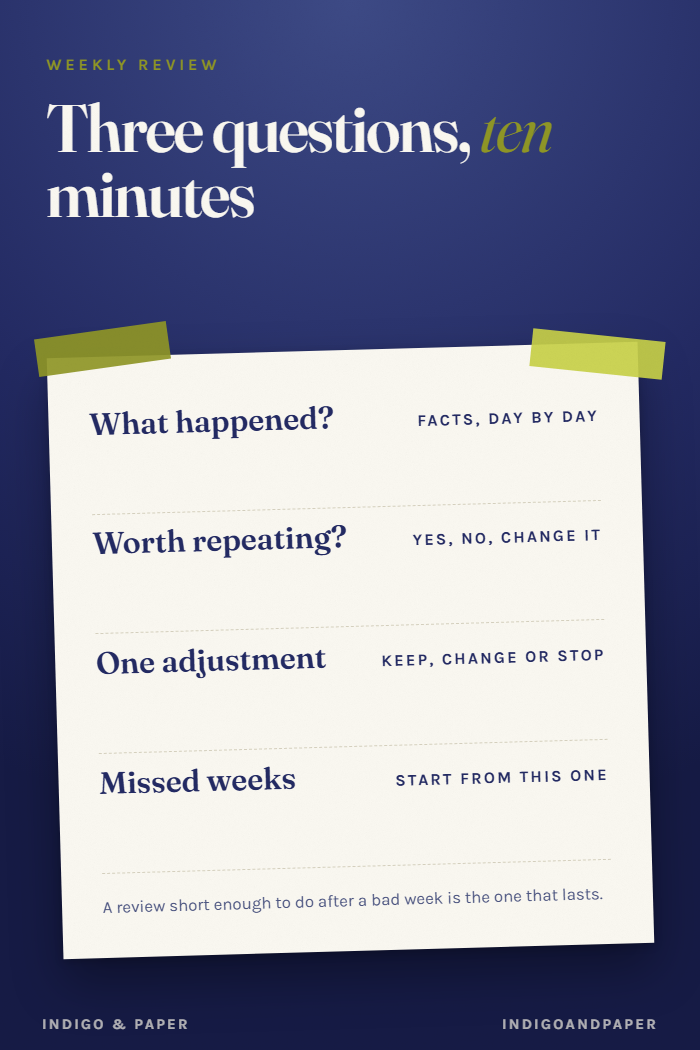
Most lists of weekly reflection questions are too long to survive. Twenty thoughtful prompts make a lovely first Sunday and a skipped third one, because the review turns into an hour of homework at the end of a week that already used up the hours.
A weekly reflection that lasts is short enough to do when the week went badly, which is exactly when it is most useful. Three questions are enough.
1. What actually happened?
Not how the week felt. What happened, day by day, in a few words. "Finished the report Tuesday." "Lost Thursday to a late meeting." "Did not cook once."
This is the question people skip, because it looks like the dull one. It is the one that makes the other two honest. Feelings about a week drift within days. A line saying what happened on Thursday does not, and a month later it is the only thing you can actually use.
2. Was it worth repeating?
For each day, or each thing you wrote down: yes, no, or change it. A morning spent packing orders before opening messages, and finishing by eleven: worth repeating. An evening lost to a meeting that ran over: change something.
This question turns a diary into a decision. It also stops a weekly review becoming a verdict on you. The question is about the week's arrangements, not your character.
3. One thing to keep, change or stop
Only one. Pick the single adjustment with the best chance of making next week easier, and write it where you will see it on Monday.
One is the whole trick. A review that ends with five resolutions ends with none, and the next review opens with a list of things you did not do.
What to leave out
Scores out of ten. They feel precise and say almost nothing a month later.
Everything you did not finish. That list already exists and is already loud. The review is for deciding, not for auditing.
Catching up. If you skip a week or three, start with the week just gone. The missing weeks stay missing. A reflection habit dies at the moment it asks you to reconstruct a month before you are allowed to continue.
When to do it, and how long
Ten minutes, on the same day each week, at a time that already exists: Sunday evening, Friday afternoon, the train home. Tie it to something you already do rather than trying to invent a new slot.
If the week was bad, do it anyway and write one line per day. A short review of a bad week is worth more than a thorough review of a good one.
For couples, students and teams
The same three questions work shared. Each person answers the first two alone, then you agree the third together. For a student, "what happened" is the week's work and deadlines. For a team, it is what shipped and what got in the way. The one-adjustment rule matters even more with several people, because every extra change needs someone to own it.
If you want it laid out for a year
A notebook with three headings does all of this and costs nothing.
If you want every week of 2027 already dated with these questions, The 2027 Planner is built around them. Each of its 53 weekly spreads has a line per day for what happened, a column asking whether it was worth repeating, and one box for the one thing to keep, change or stop. Its first page tells you to start with the current week, because earlier pages do not need filling in. Page 2 is a filled-in fictional example week. It is a 68-page hyperlinked landscape PDF for a PDF reader or for printing, $14. Goodnotes, Notability and Noteshelf have not been tested.