How to Actually Use a Planner
If you keep buying planners and stopping in February, the problem is not discipline and it is not the planner. It is what you are putting in it.
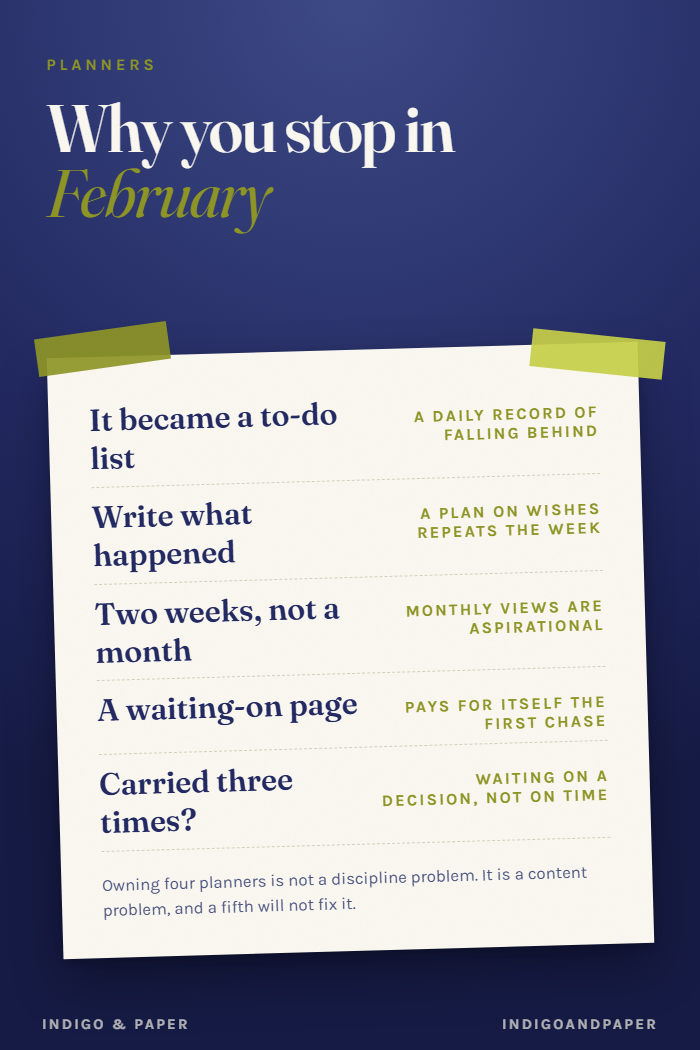
There is a specific kind of person who owns four planners. They were bought in good faith, in different Januaries, each one chosen because the last one did not work. Three are blank after week six.
If that is you, the useful thing to know is that this is not a discipline problem, and buying a fifth will not fix it. It is a content problem: what goes on the page is wrong, and no layout survives the wrong content.
The mistake: planners are used as to-do lists
A to-do list is a list of everything not yet done. It grows faster than you clear it, by design, because life adds items faster than you complete them.
Put that in a planner and the planner becomes a daily record of falling behind. Open it on Wednesday and it tells you what you failed to do on Monday. Nobody keeps opening a book that does that, and the fortnight of guilt before you stop is why the next one gets bought.
A planner is not a list of what is outstanding. It is a record of what happened and a decision about what happens next. Those are different documents and only one of them is worth reading twice.
Write down what happened, not just what is planned
This is the single change that makes the difference, and it is uncomfortable at first because it feels backwards.
Once a week — Sunday is convenient, any fixed point works — spend four minutes writing what actually happened. Not what you meant to do. What occurred.
It works for a reason that has nothing to do with motivation. A plan built on what you meant to do repeats the same week forever. A plan built on what you actually did is the only one with data behind it, and after a month you will know something specific and useful: that the thing you schedule for Monday morning never happens, that you consistently underestimate a particular task by half, that two of your recurring commitments produce nothing.
None of that is discoverable from a page of unticked boxes.
Three things worth putting on a page, and four that are not
A page earns its place when it changes a decision you would otherwise make badly. Applying that test honestly removes most of what planners come with.
Worth it:
- A two-week rolling view. Long enough to see a deadline coming, short
- enough to still be true. Monthly views are aspirational; daily views are
- administration.
- A waiting-on page. Everything you are blocked by, with who has it and
- since when. This is the page that pays for the whole system the first time
- you need to chase something.
- A decision log. The question, what you chose, the date. You will reread
- these, and you will be surprised how often you re-litigate something already
- settled.
Not worth it, for most people:
- Hourly time-blocking, unless your day is genuinely booked by other people
- Mood and habit grids that only record failure — see below
- Monthly goal pages, which are usually January's wishes rewritten
- Anything you have to set up before you can use it. [A spread that requires
- preparation is a spread that stops being
- prepared.](/journals-planners/bullet-journal-spreads-that-earn-their-page/)
The habit tracker is a special case
Almost every tracker dies between day eight and day twelve, and it dies for a structural reason rather than a personal one: the grid is built for a perfect month, so the first missed day leaves a hole and the second turns the page into evidence against you.
The fix is to remove the empty state — mark additively, so a missed day leaves nothing rather than a gap. The full mechanism is here, and it is worth understanding before you set up another one.
Audit what you carry forward
Once a month, look at everything you moved from last month and make a decision on each: do it this week, drop it, or admit it was never a task.
Anything copied forward three times is not waiting on time. It is waiting on a decision you have been avoiding, and nine times out of ten the decision is to drop it. That single page does more for how a planner feels than any layout change.
If you are choosing a new one anyway
Then choose on the tracker page rather than the cover, because that page tells you whether the person who made it has thought about why planners get abandoned or only about how they photograph. Five checks before you buy covers the rest.
---
Our 2027 planner is built on the arguments above — weeks that ask what happened, an additive tracker with nothing to leave blank, and noticeably fewer kinds of page than a planner sold on how many it has. $14.