What a Craft Business Actually Costs to Run
The monthly figure almost nobody works out, and the reason a busy month can leave you with less than a quiet one.
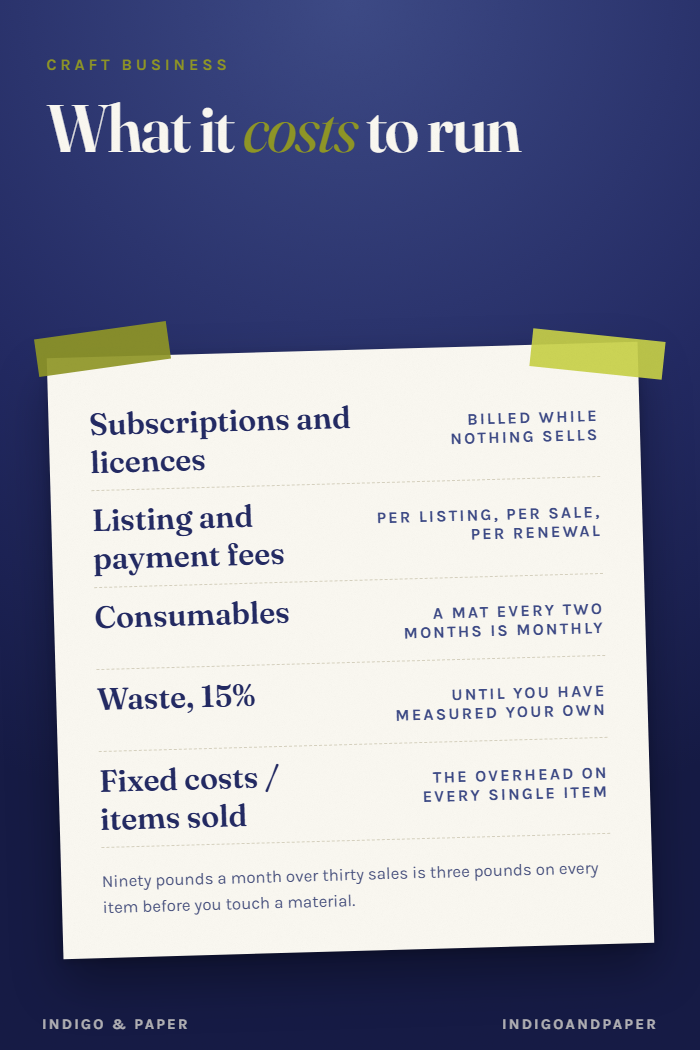
Most people starting a craft business cost the machine and stop. The machine is the one expense that announces itself. Everything after it arrives quietly, in small amounts, on different days of the month, and is never added up.
Here is the addition, in the order things actually appear.
The costs that arrive once
Genuinely one-off, and the only ones most people plan for:
- the machine
- a mat or two, and a spare blade
- whatever you bought to try it out
Call it whatever you paid. It is the least interesting number in this article, because it is spent and it is not what decides whether the business works.
The costs that arrive every month whether or not you sell
This is the set that matters, because it accrues while you sleep and while nothing sells:
- Software and design subscriptions. The design app, the font library, the
- stock-image site you signed up to for one project.
- Font and file licences. Especially the ones billed annually that you have
- forgotten renew. [Check whether they even permit selling the
- output](/cutting-machines/font-licence-four-questions/) while you are
- looking — an unusable licence is a subscription to nothing.
- Listing and transaction fees. Per listing, per sale, per renewal, plus
- the payment processor's cut, plus currency conversion if you sell abroad.
- Postage supplies bought in bulk — mailers, tape, labels, printer ink.
- The domain, the email, the scheduling tool.
- Insurance, if you sell at fairs or to shops, which many organisers now
- require.
Add them. Most people are surprised, and the surprise is usually between £40 and £120 a month before a single item is made.
The costs that are invisible because they are not money
Consumables you already own. Blades dull, mats stop gripping, printers eat ink. If you replace a mat every two months, a mat is a monthly cost, not a purchase.
Waste. Every batch has failures and every cut leaves offcuts. Until you have measured your own, 15% of materials is a reasonable placeholder.
Your time. The largest cost in almost every craft business, and the one routinely recorded as zero. It is the line that makes pricing wrong, and leaving it out does not make you cheaper — it makes you unpaid.
The number you actually want
Monthly fixed costs ÷ items you actually sell in a month = overhead per item
Not the number you hope to sell. The number you sold last month.
If your fixed costs are £90 and you sold thirty things, that is £3 on every item before you have touched a material. On a £6 keyring that is half the price gone, and it is why a busy month at the wrong price can leave you with less than a quiet one — every additional sale is carrying its own materials and time, and the fixed costs were already covered by the first few.
Why "is a craft business profitable" is the wrong question
It is profitable at some price and some volume and not at others, and those are things you set rather than discover. The question that has an answer is:
At what price does this product cover its materials, its time, its share of the overhead, and the failures?
That is arithmetic, and you can do it this afternoon.
The businesses that fail are rarely the ones with the wrong idea. They are the ones that never did this sum, priced against a hobbyist giving things away, and concluded after two years that there was no money in it — when what there was no money in was that price.
---
The overhead worksheet, the pricing sheet it feeds, a licence record and an order log are all in the Craft-Business Pack. It is not on sale yet; it goes up shortly.