An Estate Accounting Example, Worked Through in Figures
What an estate accounting includes, shown with one fictional estate from the date of death to what each beneficiary is still owed, and the one check that tells you the figures are right.
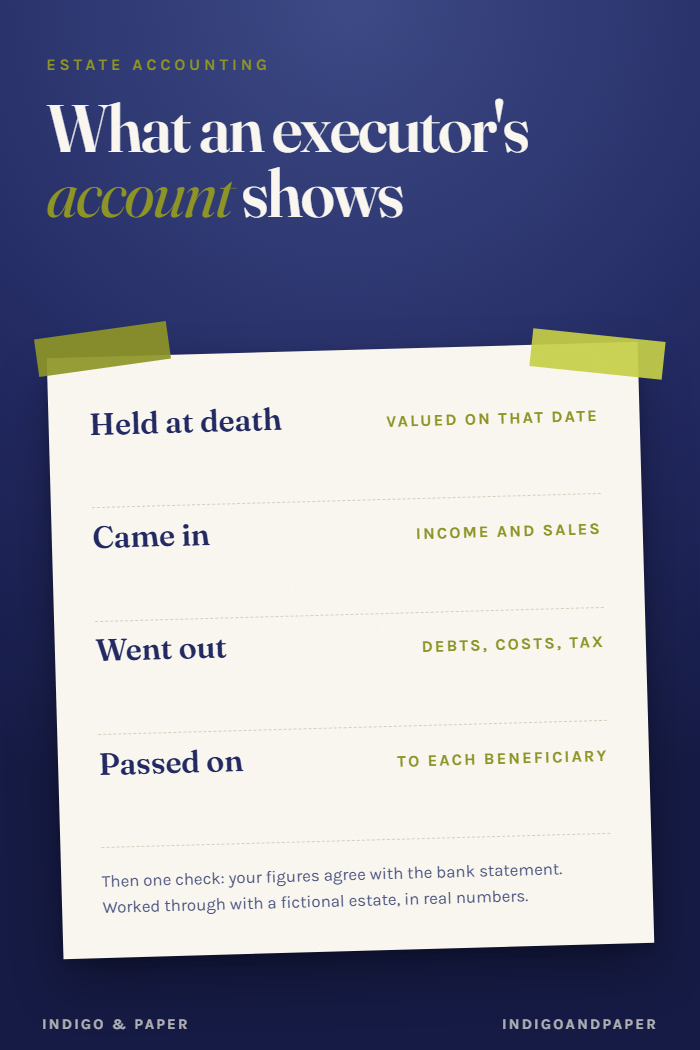
An estate accounting answers one question: of everything the person left, where is it now? Most explanations describe the parts in words. This one works through a single estate in figures, so you can see how the parts fit together and why the total has to agree with the bank.
The estate below is fictional. The layout is a common plain-language one, not a legal form. If a court, a tax authority or a lawyer where the estate is being administered asks for a particular format, use theirs; the figures carry across.
What an estate accounting includes
- What was owned at the date of death, each item at its value on that date.
- What came in afterwards: income such as interest or dividends, and the money received when assets were sold or accounts closed.
- What went out: the debts of the person who died, funeral costs, the costs of administering the estate, and any tax.
- What passed to beneficiaries, in money or as items.
- What is left, and what it is made of.
Parts 1 to 4 are enough to work out part 5. Everything else in a longer accounting is detail inside one of these.
The example: the estate of Margaret Ellis
Margaret died on 14 March 2026. Her son Daniel is executor. Her will leaves 2,000 to a local library and the rest half each to Daniel and his sister Ruth. The account runs to 30 September 2026.
What she owned at the date of death
| Item | Value at death | What happened |
|---|---|---|
| Checking account | 8,412.55 | Closed into the estate account |
| Savings account | 21,300.00 | Closed into the estate account |
| House | 245,000.00 | Sold for 251,500.00 |
| Index fund | 38,760.20 | Sold for 40,112.87 |
| Car | 6,500.00 | Given to Ruth as it was |
| Household contents | 1,500.00 | Still held |
| Utility deposit owed to her | 84.10 | Refunded |
| Total | 321,556.85 |
The house and the fund sold for more than their date-of-death values. Those differences, 6,500.00 and 1,352.67, are gains. A sale below the date-of-death value would be a loss. Valuing everything at the date of death is what lets you see this instead of losing it inside a total.
The account
| What the executor is answerable for | |
|---|---|
| Assets at the date of death | 321,556.85 |
| Income received | 372.12 |
| Gains on assets sold | 7,852.67 |
| Total | 329,781.64 |
| What has gone out or been passed on | |
|---|---|
| Debts of Margaret's, paid | 3,670.81 |
| Funeral costs | 7,850.00 |
| Administration costs (fees, insurance, agent's commission) | 17,593.31 |
| Tax paid | 1,500.00 |
| Paid to beneficiaries in money | 202,000.00 |
| Passed to beneficiaries as items (the car) | 6,500.00 |
| Total | 239,114.12 |
Balance on hand: 329,781.64 less 239,114.12 = 90,667.52.
That balance is then shown to be made of real things: 89,167.52 in the estate bank account, and the household contents still held at 1,500.00.
The check that tells you it is right
The first half of the account and the "made of" line are built from the same records, so they will always agree with each other. That is not proof.
The proof is outside the spreadsheet: the money in the estate account according to your records must equal the balance on the bank statement. Here both say 89,167.52. If they differ, a payment is missing, entered twice, or mistyped, and nothing else in the account can be trusted until you find it. Comparing your running balance with the statement's, line by line, finds the first place they part.
Income before and after the death
Margaret's accounts paid 18.40 of interest that was earned before she died but arrived afterwards, and 353.72 was earned after. Keep the two apart. Tax may treat the two periods differently depending on where the estate is, and whoever prepares any return will want them separately. This page does not say how either is taxed.
What each beneficiary is still owed
Start from the balance on hand, add back everything already passed to beneficiaries, then take off debts known but not yet paid and any fixed gifts:
90,667.52 + 208,500.00 - 0.00 - 2,000.00 = 297,167.52 left to share.
| Beneficiary | Entitled to | Received | Still due |
|---|---|---|---|
| Daniel (half) | 148,583.76 | 100,000.00 | 48,583.76 |
| Ruth (half) | 148,583.76 | 106,500.00 | 42,083.76 |
| Library (fixed gift) | 2,000.00 | 2,000.00 | 0.00 |
Ruth's received figure includes the car at its date-of-death value. The three "still due" figures add up to the balance on hand, which is a second check worth making.
These figures are right only on the date of the account. Every new bill, sale or payment of income changes them, which is why it helps to date every statement you send.
When to take advice first
This layout keeps the figures straight. It does not decide anything the law decides. Talk to a lawyer or accountant where the estate is administered before paying beneficiaries if the estate may not cover its debts, if anyone disputes the will, if there is no will, or if a court has asked for an accounting in its own form.
If you want the account laid out for you
A spreadsheet with a tab for each of the five parts above will do the job, and free ones exist.
The Executor's Account is ours: an Excel workbook with this exact example loaded, so you can see every figure on this page working before you enter your own. It checks the account against your bank statement and says BALANCED only when they agree, works out each gain or loss against the date-of-death value, and prints a one-page statement for each beneficiary. It comes with an eight-page guide, costs $19, and is a record for the executor, not legal or tax advice.