A Home Inventory for Insurance: Start With One Room
What a home inventory needs to record, why one finished room beats an unfinished house, and where the copy must live so it survives what it is for.
A home inventory is written for a day you hope never comes: when something has been stolen, flooded or burned and you are asked to list what you had. On that day you are trying to remember the contents of rooms you can no longer walk into, and memory is a poor witness. You forget the things you use least, which are often the things that cost most.
The inventory's whole job is to replace that memory with a record. It is not the claim, it does not decide what a policy covers, and it does not put a value on anything. What your insurer needs, and in what form, is a question for your insurer and your policy wording. This page is about keeping a record good enough to answer them.
Start with one room, not the house
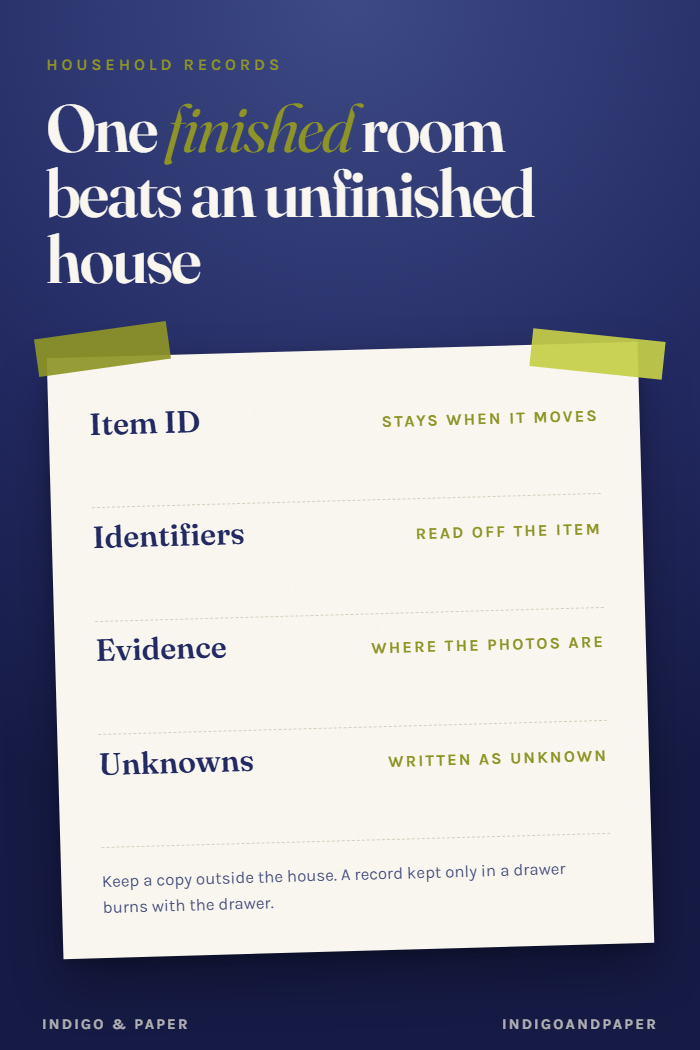
The reason most home inventories do not exist is that people start with the whole house, get halfway through the kitchen drawers and stop. An unfinished inventory of everything is worth less than a finished inventory of one room.
Pick the room where the replacement cost is concentrated. For most households that is the living room, because it holds the television, the speakers and whatever else plugs in. Finish it. Then pick the next.
What to record for each item
A stable ID. A short code that stays with the item even when it moves, like H015 for the television. It is what stops the same speaker being listed twice, once in each room it has lived in.
A description and where it is. "Television, living room" is enough to start. The ID lets you add detail later without rewriting the list.
The identifiers you can actually confirm. Brand, model and serial number, read off the item itself, not guessed from memory. A photo of the label on the back does this better than copying the numbers out by hand.
The acquired date and amount, if you have the receipt. Useful, but be clear what it is. A purchase price is what you paid. It is not the current value and it is not the insured value, and the inventory should not pretend otherwise.
What you do not know. Write "unknown" rather than leaving a gap or guessing. A record that is honest about its gaps is more believable than one that looks complete.
Photographs and where the evidence lives
A slow video walk through each room, opening cupboards as you go, captures quickly what a written list takes much longer to reach. It is free and it is the right first step if you do nothing else.
The written list earns its place alongside it by being searchable and by pointing at the evidence: for each item ID, where its photos, receipt and manual are kept. The receipts do not need to be copied into the inventory. The inventory needs to say where they are.
Where the copy has to live
This is the part most inventories get wrong. A record kept only in a drawer in the house is lost in exactly the fire it was written for. Keep the main copy somewhere you can reach from outside the home, and a second copy somewhere separate from the first, and check once that the backup actually opens.
Keep passwords and account numbers out of it. An inventory is a list of what you own and where the proof is. It should be safe to store somewhere convenient, which it will not be if it also holds the keys to your bank.
Keep it current without starting again
Choose one thing that triggers an update, something you will actually remember: a new appliance arriving, a birthday, the policy renewal letter. On that day add what is new, mark what has gone, and leave the rest alone. Items that were sold, given away or replaced should be marked as such rather than deleted, so an old photo is never mistaken for something you still own.
If you would rather it were already laid out
A spreadsheet with an ID, a description, the confirmed identifiers and a column for where the evidence lives will do everything above, at no cost. So will the video on its own, which is better than any list that never gets started.
If you want the pages ruled and in order, What We Keep is an 11-page kit built for this. Page 4 starts one room, page 5 is the item register with a stable ID column, page 6 records one item in detail including the serial number and the source you checked it against, and page 7 links each item ID to where its photos and receipts are kept. Later pages cover manuals and paperwork, things lent out, and items moved, replaced or passed on. Page 3 is a worked example of one household doing the living room first, marked as fictional.
It comes as both A4 and US Letter PDFs in one download, for $3.99. The file says plainly that it does not determine whether a warranty or policy applies, that a purchase amount does not establish insured value, and that it is not an encrypted vault.