The Executor's Account
An estate account that balances, and a statement for each beneficiary. An Excel workbook with a worked example, and an eight-page guide.
$19.00 · Made by Indigo & Paper
Get The Executor's Account — $19.00
An estate account that balances, and a statement for each beneficiary. An Excel workbook with a worked example, and an eight-page guide.
Who it is for
You have been named executor of a parent's or a partner's estate, and you are doing most of the work yourself. Accounts are being closed, bills paid, perhaps a house sold. Sooner or later someone will ask where the money went, and what each person is still owed. This keeps that answer ready.
What is in it
- Inventory of everything owned at the date of death, at its value on that date, with each item marked held, turned into money, or handed over as it is.
- Debts owed at the date of death, and what is still to pay.
- A ledger of the estate bank account, where each line is linked to an asset, a debt or a beneficiary.
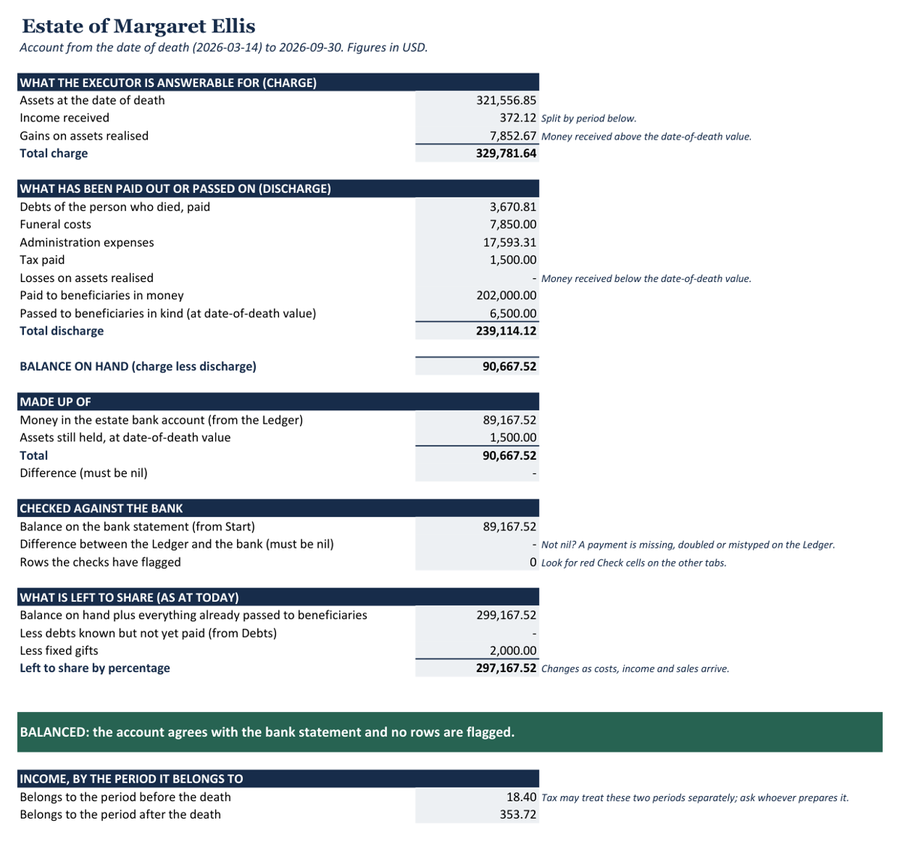
- The account: what you are answerable for, what has gone out or been passed on, and the balance on hand, with any gain or loss on a sale worked out against the date-of-death value and income split between before and after the death.
- A check against your bank statement. The status reads BALANCED only when the ledger agrees with the balance you type from the statement and no row is flagged. Otherwise it says what is wrong.
- What is left to share, after debts known but unpaid and fixed gifts, and what each beneficiary is entitled to at that date.
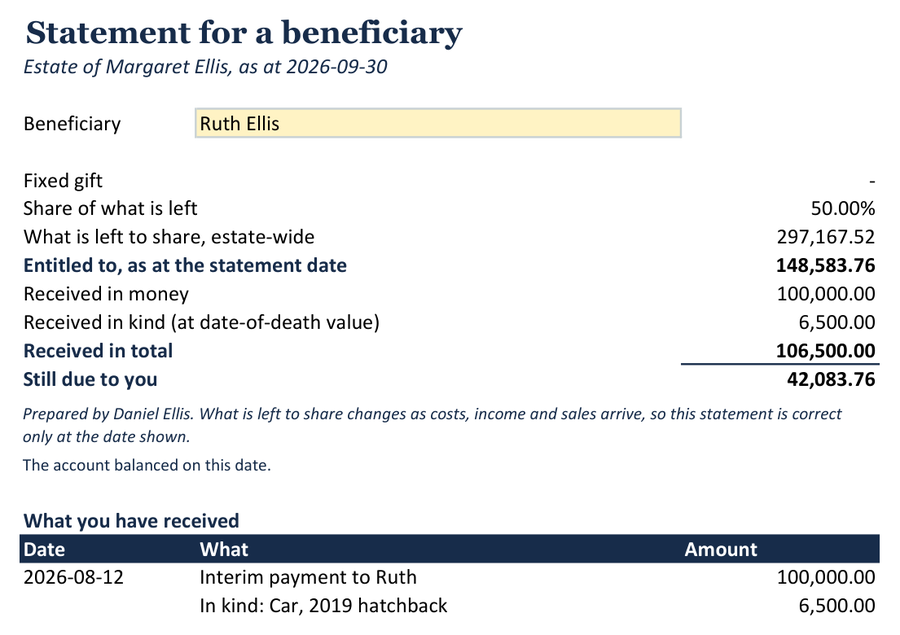
- A one-page statement for each beneficiary: their entitlement, every payment and item they have received, and what is still due.
Two copies of the workbook come in the download: a blank one to use, and one filled in with a fictional estate so you can see every tab working first. The eight-page guide, in US Letter and A4, explains how the account works, walks through the example, and lists every check message and what to do about it.
Why this rather than a free executor spreadsheet
Free executor templates exist, and some are good organisers: they list assets, debts and tasks. If a list is what you need, use one.
The difference here is the account. Most templates, free or paid, stop at a list and a total. This workbook takes each asset's value at the date of death, follows every payment in and out of the estate account, and proves the result against the bank statement, so a missing or doubled payment shows up rather than disappearing into a total. And it turns the figures into a statement each beneficiary can read.
Format and compatibility
Two Excel workbooks (.xlsx) and a PDF guide in US Letter and A4. Tested in Microsoft Excel 16 for Windows, in 56 scenarios with every expected figure worked out by hand, and with no errors in its formulas. It uses only ordinary functions and no macros, so it should open in Google Sheets, LibreOffice and Numbers, but those have not been tested: check the example in your app before you start. Room for 60 assets, 30 debts, 400 ledger lines and 12 beneficiaries.
What it is not
A record for the executor. It is not legal, tax or financial advice, and not a court or tax form, and it does not know the law where the estate is being administered. If a court, tax authority or lawyer asks for a particular form, copy the figures across from the account. If the estate cannot pay its debts in full, or anyone disputes the will, take professional advice before paying anyone.
Inside the download