How to Split Household Chores With a Partner Without Keeping Score
Most chore arguments are not about who does more. They are about what "done" means and who notices the job needs doing. Two questions settle both.
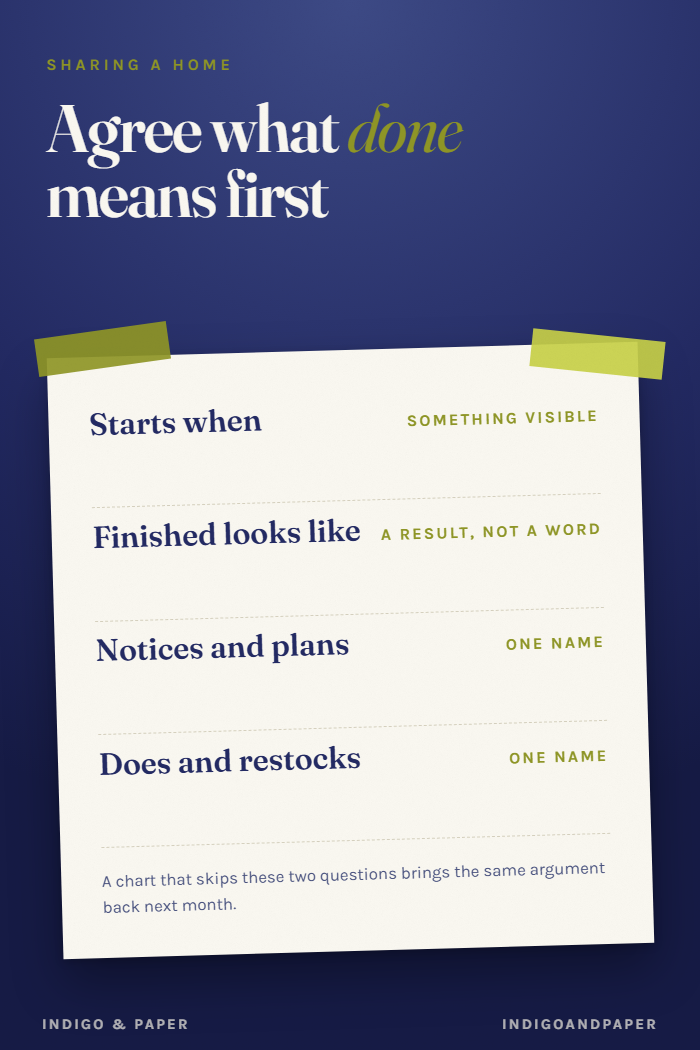
Most arguments about chores are not really about who does more. They are about two things nobody wrote down: what "done" means, and who is supposed to notice that the job needs doing in the first place. Split the tasks without settling those and the same argument comes back next month with different dishes in it.
So before anyone draws a chart, two questions.
Question one: what does finished look like?
Pick the task that causes the most friction and describe it the way you would for someone who has never lived in your home.
When does it start? Not "when it needs doing", which is the whole disagreement. Something visible: the bin is full, papers cover more than half the table, there are no clean mugs.
What does finished look like? A result you could both point at. "Kitchen cleaned" means five different things. "Worktops clear, dishes away, hob wiped" means one.
Where are the things it needs? Half of a shared task is knowing where the bin bags are.
Do the task once to that definition, then change the definition if it was wrong. It is a draft, not a contract.
Question two: who owns the whole job?
A chore is usually several jobs wearing one name. Laundry is noticing the basket is full, doing the wash, drying, folding, putting away, and noticing the detergent is running low. Shopping is noticing what is missing, writing the list, buying, and putting it away.
The doing is the visible part, and it is often the only part anyone divides. The noticing, planning and restocking stay with whoever happens to remember, and that person tends to feel they are doing more than the chart says, because they are.
So for each task, write two names, not one:
| Task | Who notices and plans | Who does and restocks |
|---|---|---|
| Laundry | ||
| Food shopping | ||
| Bins |
Sometimes it is the same person in both columns, which is often the cleanest arrangement: one person owns the whole of laundry, the other the whole of the shopping. What matters is that no column is left to whoever remembers first.
Then, and only then, the weekly chart
Once "done" and "who owns it" are agreed, the weekly chart is short. A few specific outcomes per day, not every task every day, and a blank day allowed. Write down what can move if the week changes, because it will.
Review it after a week, briefly: what got easier, what took longer, and one thing to change. Arrangements that never get reviewed drift back to the old split without anyone deciding they should.
Why not keep score?
Tallying minutes or tasks feels fair and can make things worse, because it turns a shared home into a ledger, and working hours, health and capacity change from month to month. An agreement you revisit handles that. A score does not. The aim is a split you both think is workable, written down so neither of you has to remember it.
If you want it on paper
A shared note or spreadsheet with the columns above does everything here and costs nothing. Plenty of households run on exactly that.
If you would rather the pages were already drawn, A Home That Works is a 13-page household kit built around these two questions. Page 5 is the "what finished means" sheet, with a start signal, the finished result, the steps and who is responsible. Page 6 splits each task into who notices and plans and who does and restocks, and says outright that it records a conversation, not a score. Page 7 is the week at a glance, page 12 restarts after a missed week without the backlog, and page 13 is the short review. Page 3 is a worked example of two flatmates clearing a dining table, marked as fictional.
It is $3.99 as A4 and US Letter PDFs, and it is also one of five kits in The Household Set.