Keeping a Moving Box Inventory: Number the Box, Not the Contents
The four columns a moving box inventory needs, why a number beats a description on the box, and how the list tells you which box did not arrive.
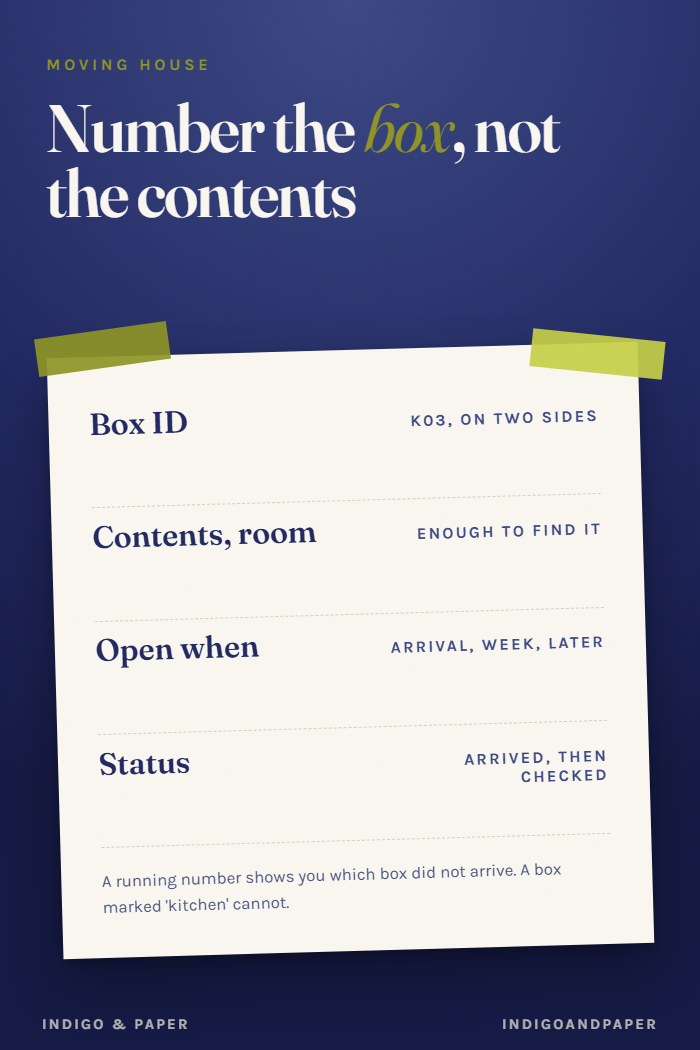
A moving box inventory has one job, and it is not the one most templates are built for. It is not there to record everything you own. It is there so that on the first evening in a new place you can find the kettle lead without opening eleven boxes, and so that a week later you can say with confidence which box never turned up.
Both of those depend on the same decision, made before the first box is packed: the box carries a number, and the list carries the detail.
Why a number and not a description
Writing "KITCHEN MISC" on a box feels like labelling. It tells you almost nothing when there are six boxes that say it. A number does two things a description cannot.
It points at exactly one line on the list. The box says K03. The list says K03 holds the everyday pans and the kettle lead. You can write as much or as little on the list as you like without running out of cardboard.
It makes a missing box visible. If the kitchen boxes run K01 to K12 and you can only find eleven, you know which one to ask about. A pile of boxes marked "kitchen" cannot tell you that anything is missing at all.
Use a short room code and a running number: K for kitchen, B for bedroom, L for living room, S for storage, or whatever letters make sense in your home. Decide the codes before packing starts, not halfway through, or the second bedroom ends up as B, B2 and SPARE on three different boxes.
Write the ID on at least two sides, not only the top. Boxes get stacked, and the top of a box in the middle of a stack is the one face you cannot read.
The four columns
Box ID. The code from the box. Nothing else goes in this column.
Contents and destination. A few words that would let you pick this box out of the stack when you need something from it, plus the room it goes to. "Winter clothes, bedroom" is enough. You are not writing a catalogue. If you would not look for it in this box, it does not need listing.
Open when. The column most lists leave out, and the one that makes the first night bearable. Three answers cover nearly everything: on arrival, this week, or later. The boxes marked "on arrival" are the only ones you open on day one. Everything else can wait without anyone going without.
Status. A tick when the box reaches its room, and a second when it has been opened and checked. That second tick is how you notice, three weeks in, that a box marked "later" was never actually unpacked.
Beside the four columns, one line is worth keeping at the bottom of the page: where the detailed list or photographs are kept, if you made them. That matters for anything valuable or fragile, where a photo of the contents taken before the tape goes on is far more useful than any description, and where you would rather not advertise what is inside on the outside of the box.
Paper, a spreadsheet or an app
All three work. A spreadsheet with the four columns above is completely adequate, and there are apps that print QR labels and link each box to photos. If one of those suits you, use it.
The argument for a sheet of paper is narrow and practical: on moving day your phone is the thing you are using for everything else, it is low on battery by the afternoon, and the person unloading the van cannot read your screen. A clipboard with the register on it can be handed to whoever is carrying boxes in, and they can put each one in the right room without asking you.
If movers are doing the loading and they make an inventory of their own, keep yours anyway. Theirs counts what they carried. Yours says what is inside and when you need it, and comparing the two counts at the other end takes a minute.
When the list is finished
Keep it until every box has its second tick. The last useful thing it does is tell you what is still unopened. After that, if you think you will move again, one line on what you would label or pack differently is worth more than any checklist written by somebody else.
If you would rather it were already laid out
Four columns ruled on a sheet of paper do everything above, and cost nothing. That is a genuinely good answer.
If you want the register printed along with the rest of the move, Move, With a Plan is an 11-page kit built around it. Page 6 is the box register, with the same columns described here and a line for where the detailed lists and photos live. Page 5 assigns the room codes before anything is packed, page 7 is the first-night bag and who carries it, and page 8 records move-day times and who has confirmed them. Page 3 is a worked example of a two-person flat move, marked as fictional.
It comes as both A4 and US Letter PDFs in one download, for $2.99. It is a packing record, not a removals plan or a legal checklist, and the file says so on its worked-example page.