How to Price Handmade Soap by the Batch, Then by the Bar
Soap is costed by the batch and sold by the bar. Trim losses, labels and your time decide the bar price far more than the oils do.
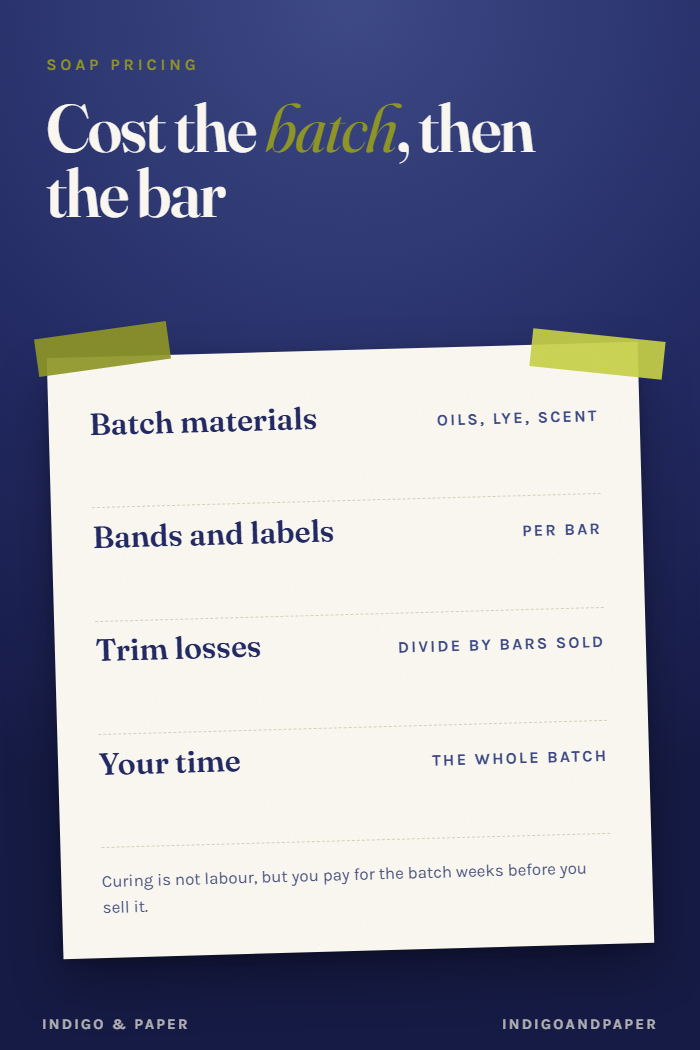
Soap is made by the batch and sold by the bar, and most pricing mistakes happen in between. The oils are counted carefully. The end pieces trimmed off the loaf, the labels, and the ninety minutes of weighing, mixing, pouring, cutting and wrapping are not. And unlike most crafts, you pay for a batch weeks before you can sell it.
The general method is in how to price what you make. This is how it applies to soap.
Cost the whole batch
Everything below uses invented numbers, to show the arithmetic. Use your own recipe and supplier prices.
For a loaf that cuts into ten bars:
- oils and butters: $9.00
- lye: $1.20
- fragrance or essential oil: $3.00
- colour and additives: $0.60
That is $13.80 for the batch. Add what each bar goes out in: a band or wrap and a label, say $0.25 a bar, so $2.50 across ten. Batch materials: $16.30.
Divide by the bars you can actually sell
Ten bars cut is not ten bars sold. End pieces, a bar with a flaw, and the offcuts from bevelling come out of the batch. If nine sellable bars come out of every ten cut, each carries $16.30 ÷ 9, which is about $1.81 of material.
Time the batch, including the wrapping
Weighing, mixing, pouring, cutting, bevelling, labelling and wrapping. Time a whole batch once. In the example, ninety minutes across nine sellable bars is ten minutes a bar, which at $18 an hour is $3.00.
Curing time is not labour, since you are not working while bars cure. It does mean materials are paid for long before the sale, which matters when you decide how many batches to make ahead of a market.
Overhead, fees and margin
Moulds, the scale, safety gear and the stick blender wear out or get replaced. Spread them per bar. Say $0.20.
Cost per bar: $1.81 + $3.00 + $0.20 = $5.01.
Fees are a percentage of the price, so divide rather than add. With an illustrative 8% in fees and a 30% margin:
$5.01 ÷ (1 − 0.08 − 0.30) = $5.01 ÷ 0.62 ≈ $8.08
That is a floor for this example, not a price to copy. A larger batch, a cheaper fragrance or a smaller bar will each move it.
One thing that is not pricing
What you may say about soap on a label, and whether a product counts as soap or as a cosmetic, depends on the rules where you sell. Check them before you list. This page covers only the arithmetic.
If you want the arithmetic done for you
Paper or any spreadsheet will do, once you have timed a batch.
The Maker's Pricing Workbook is a spreadsheet built around batches. Its Batch costs tab takes a batch's materials in twelve rows, with six labour rows and six overhead rows, and divides by the bars you can actually sell, so trim losses come out of the cost rather than your pocket. Its Price tab takes fees, shipping, discounts and a target margin you choose, and a status line flags when your price misses it. It has been opened and recalculated in Microsoft Excel for Windows. Google Sheets and Excel for Mac have not been tested. It will not tell you what to charge. $6.99.