How to Price Crochet Items When the Hours Are Most of the Cost
Yarn is the easy part. The hours are what make crochet pricing uncomfortable, and there are only three honest ways to deal with them.
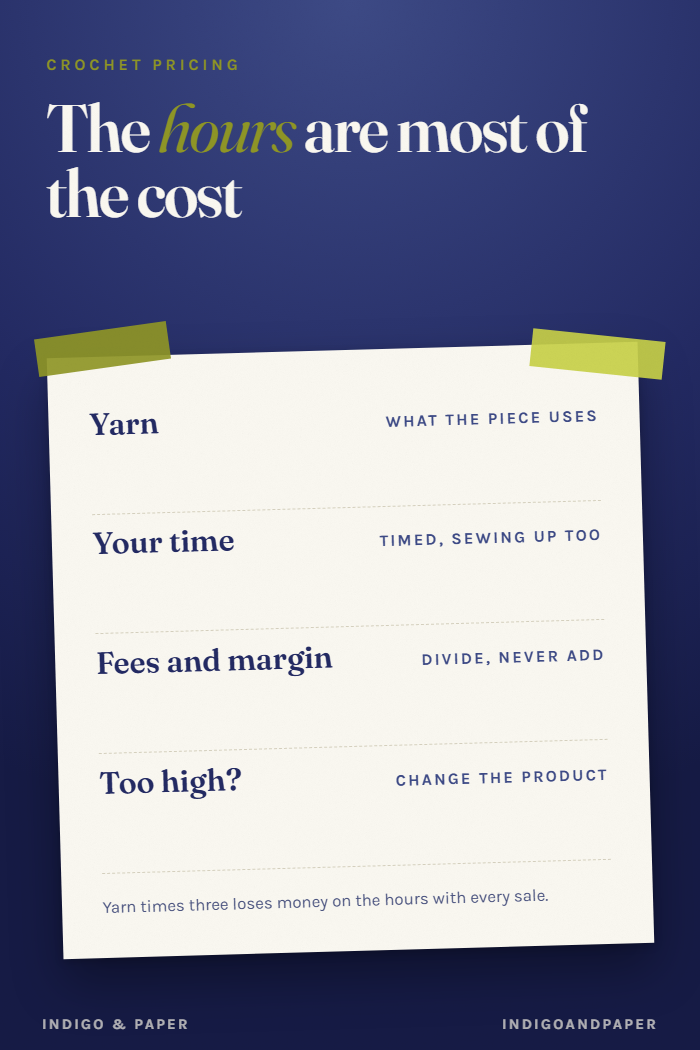
Most crochet pricing questions are really one question: what do I do about the hours? The yarn is easy to count. The time is where the price becomes a number nobody wants to write down, and where most makers quietly give their work away.
There is no formula that makes a forty-hour blanket cheap. There is a way to see what it actually costs, and then three honest choices.
Yarn, counted by what the piece uses
Price the yarn the item uses, not the skeins you bought. If a toy uses about a third of an $8.00 skein, that is about $2.40 of yarn. Add everything else that goes out the door with it: stuffing, safety eyes, buttons, a label, the bag.
An illustration with invented numbers, for a small amigurumi: $2.40 of yarn, $0.30 of stuffing and $0.20 of safety eyes, so $2.90 in materials.
Weigh a finished piece and the leftover yarn once, and you will know the real figure for every copy after that.
The hours, timed, at a rate you would accept
Time one piece from the start: making, assembly, sewing ends in, blocking if it needs it, photographing and packing. Most people underestimate the sewing-up and the photographs.
Then choose an hourly rate you would accept for work you are good at. Not the rate you think buyers will tolerate. That comes later.
In the example, three hours at $15 an hour is $45. Next to $2.90 of yarn and parts, this is the whole story of crochet pricing.
Overhead, fees and a margin
Hooks, stitch markers, a share of the camera or phone, shop subscription and listing fees are real even when nothing sells. Spread them per item, say $0.50 in the example. Cost is now $48.40.
Fees are a percentage of the price, so divide rather than add. With an illustrative 8% in fees and a 20% margin:
$48.40 ÷ (1 − 0.08 − 0.20) = $48.40 ÷ 0.72 ≈ $67.22
That is what the example toy costs to make honestly, not what anyone must pay. Your hours, rate and yarn will give a different number.
Three honest choices when the number looks too high
Charge it, and sell fewer. Some buyers want handmade and understand the hours. Say what the piece involves in the listing, with the time, and let the price explain itself.
Change the product, not the price. Smaller pieces, faster stitches, chunkier yarn, or a design you have made often enough to be quick. The price comes down because the hours did, which is the only way it comes down without you paying for it.
Decide it is a hobby that pays for its yarn. That is a perfectly good choice, as long as it is a choice. The trouble starts when a price set for a hobby turns into what customers expect from a business.
What does not work is pricing at yarn times three and hoping volume makes up the difference. At $8.70 for the example toy, every sale loses money on the hours.
Blankets and commissions
Large pieces follow the same arithmetic with far more hours. That is why blankets are so often priced far below cost, and why a commission quote should come from a timed sample, not from a guess. Quote the hours you expect, and say what happens if the pattern or the size changes.
If you want the arithmetic done for you
A sheet of paper or any spreadsheet will do this once you have the timings.
The Maker's Pricing Workbook is a spreadsheet set out in this order. Its Batch costs tab has twelve material rows, six labour rows and six overhead rows, divided by the pieces you can actually sell. Its Price tab takes fees, shipping, discounts and a target margin you choose, and flags when your price misses it. The guide gives a page to the difference between margin and markup. It has been opened and recalculated in Microsoft Excel for Windows. Google Sheets and Excel for Mac have not been tested. It will not tell you what to charge. $6.99.