How to Price Candles From the Jar Up
Wax is rarely the biggest cost in a container candle. The vessel often is, and test burns, batch size and your pouring time decide the rest.
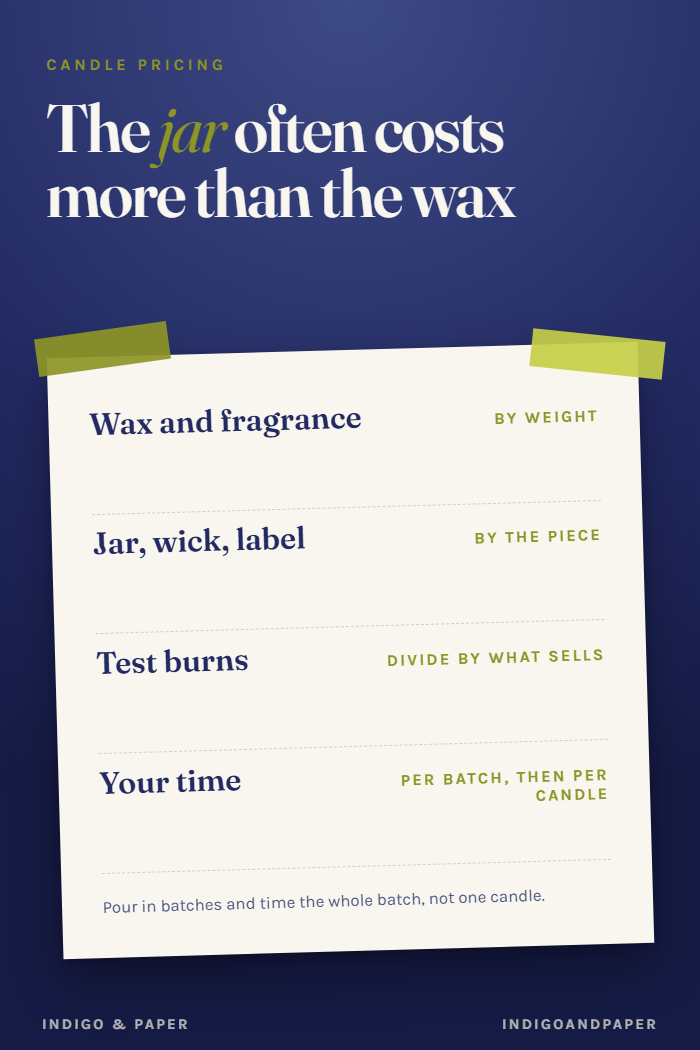
People pricing candles tend to start with the wax, because it is the part that feels like the candle. In a container candle it is often not the biggest material cost. The jar usually is. And the costs that decide whether a candle business pays are the ones that do not melt at all: the test burns, the batch you pour at once, and the time it takes to wick, top up, label and pack.
The general method is in how to price what you make. This is how it applies to candles.
Materials, by weight and by the piece
Everything below uses invented numbers, to show the arithmetic. Use your own supplier prices.
For an 8 oz container candle:
- wax: about 7 oz at $0.20 an ounce, so $1.40
- fragrance: at a load of 8% of the wax weight, 0.56 oz at $1.50 an ounce, so $0.84
- wick: $0.15
- jar and lid: $1.60
- labels, including the warning label: $0.20
- box or wrap: $0.40
Materials: $4.59, and the jar alone is more than the wax.
Weigh rather than estimate. Fill and fragrance load vary by vessel and by what your wax and fragrance suppliers recommend.
Test burns and seconds are a real cost
Some candles do not make it to sale: a wick that drowns, a tunnel, a jar that cracks, and the candles you burn deliberately to test a new wick or scent. If one candle in fifteen is not sellable, the others carry it: $4.59 becomes about $4.92 per candle you can sell.
Pour in batches, and time the whole batch
Labour is cheapest per candle when it is spread over a batch. Time a whole batch, from melting to packed boxes: weighing, melting, adding fragrance, wicking, pouring, topping up, labelling and packing.
In the example, a batch of twelve takes ninety minutes, which is 7.5 minutes a candle. At $18 an hour that is $2.25.
Curing time is not labour, because you are not working while candles cure. It does mean you pay for materials well before you can sell, so it is worth counting when you decide how much stock to pour.
Overhead, fees and margin
Pouring pitchers, a thermometer, a scale, and the candles you burn to test things all wear out or get used up. Spread them per candle. Say $0.30.
Cost per candle: $4.92 + $2.25 + $0.30 = $7.47.
Fees are a percentage of the price, so divide rather than add. With an illustrative 8% in fees and a 30% margin:
$7.47 ÷ (1 − 0.08 − 0.30) = $7.47 ÷ 0.62 ≈ $12.05
That is this example's floor, not a price for anyone else's candles. A cheaper jar, a bigger batch or a different fragrance load changes it, and shipping glass costs more than most things.
One thing that is not pricing
Candle labelling and safety rules depend on where you sell. Check the rules for your market and your suppliers' guidance before you list. This page only covers the arithmetic.
If you want the arithmetic done for you
Paper or any spreadsheet will do, once you have timed a batch.
The Maker's Pricing Workbook is a spreadsheet laid out in this order. Its Batch costs tab has twelve material rows for wax, fragrance, wicks, jars and labels, six labour rows and six overhead rows, divided by the candles you can actually sell. Its Price tab takes fees, shipping, discounts and your own target margin, and a status line flags when your price misses it. It has been opened and recalculated in Microsoft Excel for Windows. Google Sheets and Excel for Mac have not been tested. It will not tell you what to charge. $6.99.