How to Price Handmade Jewelry When Metal Prices Move
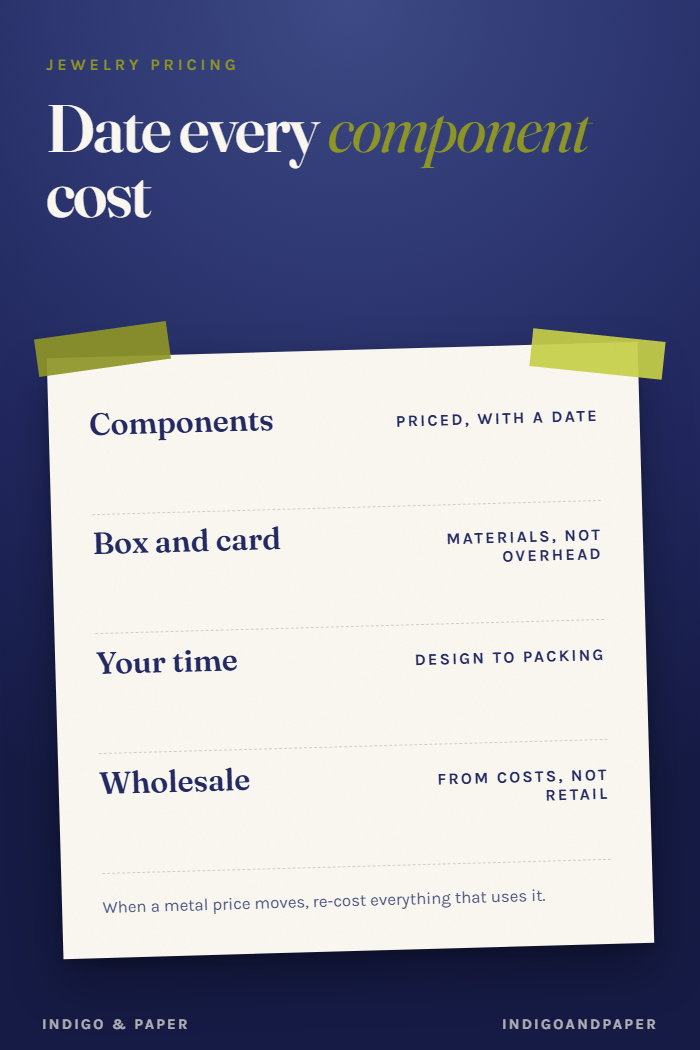
Components are easy to count and easy to let go out of date. Price from a dated component cost, count your time honestly, and re-cost when you reorder.
Jewelry is one of the easier crafts to cost and one of the easiest to let slip out of date. Components come in counted packs, so the materials look straightforward. But metal prices move, and a price set when silver was cheaper quietly becomes a loss the next time you reorder. The other usual gap is the same as in every craft: the time.
The general method is in how to price what you make. This is how it applies to handmade jewelry.
Cost every component, with a date
Everything below uses invented numbers, to show the arithmetic.
For a pair of earrings:
- sterling ear wires: $1.20 a pair
- beads and charms: $2.40
- jump rings and findings: $0.20
- card and box: $0.90
Materials: $4.70. The box and card are part of what the customer buys, so they belong here, not in overhead.
Write the date beside each component cost. When you reorder at a different price, update it and re-cost everything that uses that component. The date is what tells you a price has gone stale.
Waste and mistakes
Wire offcuts, a jump ring that will not close cleanly, a bead that cracks. If these add about 5% to what a piece uses, divide by 0.95: $4.70 becomes about $4.95.
Time, including the parts that are not making
Time one piece from start to finish: design, making, finishing and polishing, photographing, listing and packing. Twenty minutes at $18 an hour is $6.00, already more than the materials in this example.
Repeat designs get faster. Price a design from its current time, and let the price follow when it genuinely drops, rather than pricing new designs as though you had already made fifty.
Overhead, fees and margin
Pliers, cutters, a mandrel, polishing cloths, photography and listing fees recur whether or not you sell. Spread them per piece. Say $0.40.
Cost per pair: $4.95 + $6.00 + $0.40 = $11.35.
Fees are a percentage of the price, so divide rather than add. With an illustrative 8% in fees and a 30% margin:
$11.35 ÷ (1 − 0.08 − 0.30) = $11.35 ÷ 0.62 ≈ $18.31
That is a floor for this example, not a recommended price. Precious metal, gemstones or longer making times move it a long way.
Wholesale and consignment
A shop that buys to resell usually needs to mark your price up, so a retail price built on this arithmetic may not leave room for a wholesale discount. Work out the wholesale price from your costs first, rather than taking a percentage off retail. The general guide covers why wholesale is not "the price minus a bit".
If you want the arithmetic done for you
A spreadsheet with dated component costs will do.
The Maker's Pricing Workbook is a spreadsheet set out in this order. Its Batch costs tab has twelve material rows for components and packaging, six labour rows and six overhead rows, divided by the pieces you can actually sell. Its Price tab takes fees, shipping, discounts and your own target margin, and flags when your price misses it. When a component price changes, you change one cell. It has been opened and recalculated in Microsoft Excel for Windows. Google Sheets and Excel for Mac have not been tested. It will not tell you what to charge. $6.99.