Keeping a Newborn Feeding Log, and What to Put in It
What the columns are for, why paper survives the four a.m. version, and how to keep one without it becoming another thing to fail at.
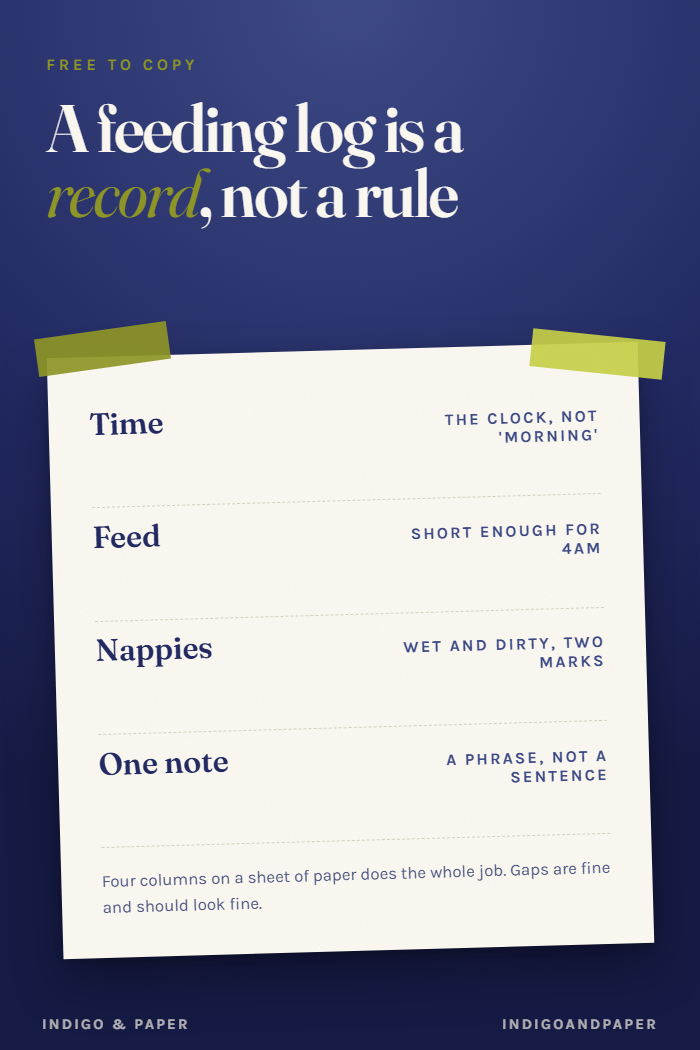
A feeding log is a record, not an instruction. It does not tell you how often a baby should feed or how much. It tells you what happened, so that when somebody asks, you are not trying to reconstruct the last three days from memory at a point in your life when memory is the first thing to go.
That is the whole case for keeping one, and it is worth being clear about the limits before the columns. Nothing here is medical guidance. Questions about feeding, weight, output or anything that worries you belong with your midwife, health visitor, paediatrician or doctor, who will also tell you if they want something specific recorded and in what form. If they do, their format wins over anything below.
The four columns that do the work
Time. The single most useful field, and the one people leave out first. Not "morning", the actual clock time. The question you will be asked is almost always "when was the last one", and a time answers it in one word.
Feed. Which side, or how much, or both, depending on how you are feeding. Keep the notation short enough that you will still use it at four in the morning. L and R, or a number, is enough.
Nappies. Wet and dirty, as two marks. This is the column people find embarrassing to keep and then quote most often, because it is the one a clinician asks about directly.
A note. One phrase, not a sentence. "Fell asleep halfway." "Very fussy after." "First time she finished." The notes are what turn a grid of times into something you can actually read back.
Sleep is worth a fifth column if you want it, though it is harder to record honestly than it looks, because you are asleep for some of it.
Why paper, and why that is not nostalgia
Apps are genuinely good at this and several are free, so use one if it suits you. Two practical arguments for a sheet on the side:
It works one-handed and in the dark, with no screen. A phone at four in the morning wakes you up more than the baby did. Paper does not need unlocking.
Anyone can add to it. A partner, a grandparent, a night visitor. Shared app accounts are a small piece of admin nobody wants in week one, and the handover usually happens while one of you is half asleep and the other is leaving the house.
And it does not nag you. Which matters, because the failure mode of every log is the same one habit trackers have: the day you miss makes the page look like a verdict, and then you stop opening it.
Keep it survivable
Two rules, and both are about lowering the bar rather than raising it.
Record it when it happens or not at all. Reconstructing at the end of the day produces a document that is half invented, which is worse than a document with gaps.
Gaps are fine and should look fine. You will miss feeds. A log with missing rows is still a log. Anyone reading it, including you, can see the shape of the last few days from what is there.
Most people stop needing it somewhere in the first six to eight weeks, which is also worth saying out loud: it is a temporary document for a temporary period, not a habit you are supposed to keep up.
If you want one already drawn
You can rule four columns on a sheet of paper and you will have everything above. That is a completely reasonable answer and it costs nothing.
If you would rather it were already laid out, and in the same file as the pregnancy that preceded it, The Pregnancy & New-Baby Planner carries four 24-hour care logs on pages 77 to 80, ruled for time, feed, nappy, sleep and a note. Page 86 is a separate sheet for what actually settles your baby, including a column for what did not work, which is the part you forget having tried.
It is a 103-page A4 PDF at $14, one-time download, and the logs are the last section rather than the whole book: before them are the week-by-week pages, the appointment calendar and the postpartum support pages.
Page 2 says plainly that it is for organisation and reflection and not medical advice, screening or emergency guidance. That is also the honest description of this article.
There is more on what to look for in the pages after the birth if you are still choosing, including where the free options are genuinely better.