What to Put in a Family Records Binder, and What to Keep Out
Not an archive of every document you own. An index somebody else could read, on the day you are not there to be asked.
Think about the ordinary questions rather than the dramatic ones. Who is the landlord and what is the number. Which vet, and is the cat on anything. Where is the boiler service record, because the boiler has stopped and the plumber is asking. When does the car insurance renew.
You know all of that. The point of writing it down is that on the day somebody else needs it, you may be in hospital, abroad, or simply unreachable for two days, and the person standing in your kitchen has no way to find any of it.
That is a narrower job than most advice about emergency binders, and it is the one worth doing first.
It is an index, not an archive
The common mistake is to start photocopying. Deeds, certificates, policies, statements. That produces a fat binder, takes a weekend, and is out of date in four months, which is why most of them are abandoned half-finished.
A far more useful document says where things are and who to ask, in one place, on a few pages. Not the policy: the insurer's name, the policy number if you are comfortable writing it, and the drawer the paperwork is in. Not the deed: which solicitor holds it.
An index is short enough to finish and short enough to keep current, and those two properties are most of whether it exists at all when it is needed.
Keep passwords out of it
This is the one firm rule, and it is a decision rather than a preference.
Plenty of well-made free templates include fields for usernames and passwords. It is an understandable choice, because that is genuinely what a person taking over would want. But the moment the sheet holds live credentials, it has to be locked away from exactly the people it was written for, and a binder nobody can reach is not a binder.
Write the location instead. "Barclays current account, statements in the grey folder, Dad has the details" tells a trusted person what to do next without being a document that can empty an account if it is photographed on a kitchen table.
If you do want credentials shared, that belongs in a password manager with an emergency-access or legacy-contact feature, which is built for it. Not here.
And keeping passwords out does not make the rest safe. A completed index still holds addresses, account numbers, dependants' details and the name of your child's school. Treat it as sensitive, decide deliberately who has a copy, and do not leave it somewhere a visitor would find it by accident.
Three groups to start with
Not fourteen sections. Three, because three can be finished in one sitting.
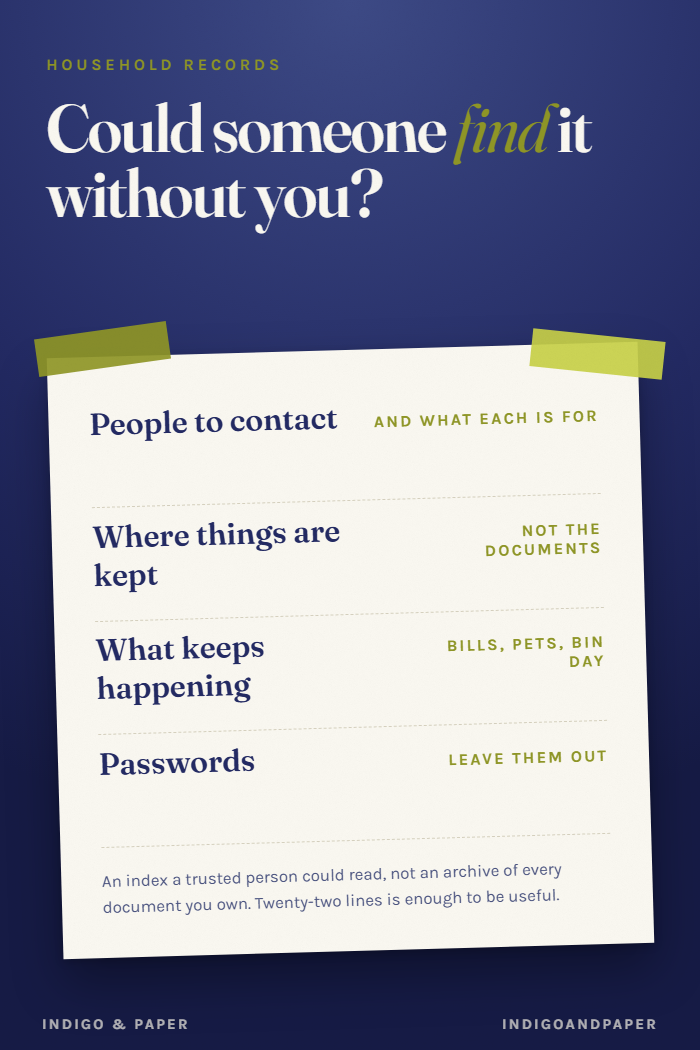
People to contact. Whoever would actually be rung: the other parent or next of kin, the employer, the landlord or the mortgage lender, the GP surgery, the vet, the school, the one neighbour with a key. Name, relationship, number, and one line on what they are for.
Where information is kept. Not the documents, their locations. Passports, birth certificates, the will and who drafted it, insurance paperwork, the boiler and appliance records, the car documents, the folder or drive where bills are filed.
What has to keep happening. The part everyone forgets, and the part that goes wrong within forty-eight hours. Standing payments and roughly when they leave the account. The cat's medication. Bin day. The prescription that needs reordering. The thing that gets watered.
A filled example
Invented household, invented names, no real references. This is roughly the density that turns out to be useful.
PEOPLE
  Next of kin      Marta Vance (sister)      07700 900118
  Landlord         Kestrel Lettings, Dan R.  07700 900204  repairs + rent
  Vet              Fieldway Veterinary       01632 960145  Biscuit, reg. there
  School           St Aubin's Primary        01632 960077  ask for the office
  Neighbour        Ade at no. 14                           has a spare key
WHERE THINGS ARE Passports bedroom, grey box file, top shelf of the wardrobe Birth certs same box Tenancy email folder "Flat", and a printed copy in the box Boiler service kitchen drawer, stapled to the manual Car documents glovebox folder; MOT due each March Bills all on email, filed under "House"
WHAT KEEPS HAPPENING Rent 1st of the month, standing order Biscuit thyroid tablet, every morning, with food Bins recycling alternate Tuesdays, general every Tuesday Council tax monthly, direct debit, stops in Feb and Mar ```
Twenty-two lines. A person who had never been in that flat could keep it running for a fortnight from those, and none of it is a document that needs locking in a safe.
Who should be able to read it, and when to revisit it
Decide this explicitly rather than by default. Usually it is one or two people: the person who would actually turn up, and one other in case the first is travelling with you. Tell them it exists and where it is. An index nobody knows about is the same as no index.
Then revisit it when something changes rather than on a schedule you will not keep. A move, a new tenancy, a new job, a new pet, a death, a separation, a child changing school. Each of those invalidates a handful of lines, and it takes ten minutes to correct them at the time and an afternoon to reconstruct them later.
What this is not
It is an organisational reference. It is not legal, financial or medical advice, and it does not do the work of a will, a power of attorney or an advance directive. Those are real instruments with real requirements, and they belong with a qualified professional. Writing down where your will is kept is useful; writing something that reads like one is not.
If the three groups above are enough, you are done, and the free version of this is a sheet of paper.
If you want the longer version already laid out, The Just-in-Case Family Records Binder is this argument as 63 A4 pages you fill in: the household at a glance and the emergency contacts at the front, then a health and care index, important documents, home and property, a digital account index and devices, people to notify, preferences and practical wishes, and a review log for keeping it current. It asks for locations and references rather than passwords, for the reason above. $12.99, one-time PDF download, and pages 5 and 7 are on its own page so you can read the two most important sheets before deciding.