Choosing Fountain Pen Ink
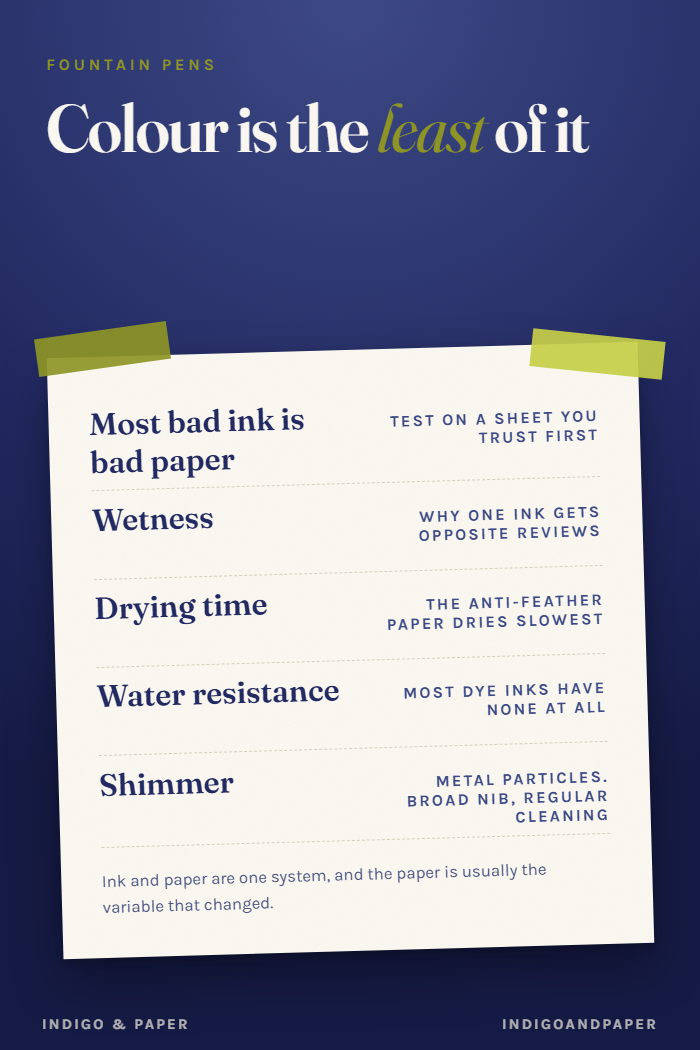
Colour is the least important property. Five others decide whether an ink behaves, and most "bad ink" is really a paper mismatch.
Ink is sold on colour and chosen on colour, and colour is the one property that has no effect on whether the pen works.
The properties that matter are less visible, and one of them is not a property of the ink at all.
Most "bad ink" is a paper mismatch
Before blaming a bottle: the same ink that feathers into a fuzzy mess on office paper can lay a crisp line on a well-sized sheet. Ink and paper are one system, and the paper is usually the variable that changed.
If an ink misbehaves, test it on a sheet you know is good before concluding anything. Why gsm is the wrong number and sizing is the right one explains what "good" means here, and it is not weight.
With that established, here is what genuinely differs between inks.
Wetness
How readily the ink flows. A wet ink lays down more of itself for the same nib and pressure.
Wet ink on a dry-writing or fine nib is a good pairing — it compensates. Wet ink on an already-wet broad nib on mediocre paper is where feathering and bleed-through come from. Dry inks are the fix for a pen that lays down too much, and they are also the ones most likely to skip in a nib that is already stingy.
Wetness is why the same ink is described as excellent by one person and awful by another. They are not using the same pen.
Drying time
Ranges from a couple of seconds to well over half a minute on coated paper.
It matters more than people expect if you are left-handed, if you write in a bound notebook where the facing page closes onto fresh ink, or if you are writing something that goes straight into an envelope.
Saturated and wet inks generally dry slower. Well-sized, coated paper — the same paper that stops feathering — also dries slower, because the ink is sitting on the surface rather than soaking in. That trade-off is real and there is no ink that escapes it.
Water resistance
Most standard inks are not water resistant at all. A drop of rain on an envelope, or a wet thumb, and the line is gone.
Three broad categories, and they behave differently:
- Standard dye inks — the majority. Vivid, easy to clean out, no water
- resistance to speak of.
- Iron gall inks — genuinely permanent and historically the archival
- choice. Modern formulations are far gentler than old ones, but they are
- still the category that most rewards cleaning the pen regularly and not
- leaving it full for months.
- Pigmented inks — permanent because the colourant is suspended particles
- rather than dissolved dye. Excellent water resistance; will dry solid inside
- a pen left unused, and that is a harder clean than dried dye ink.
For a letter that might be kept for decades, this is the property to think about. For a shopping list it is irrelevant.
Saturation, and what it costs
Highly saturated ink gives a dense, striking line. It also tends to dry more slowly, feather more readily on poor paper, and stain a demonstrator or a light-coloured converter.
Low-saturation inks look washed out on their own and often show far more shading — light and dark variation within a stroke — which is the effect many people actually want when they say they want an interesting ink.
Shimmer and sheen, which are not the same thing
Sheen is an optical effect from the dye itself, visible where ink pools. It costs nothing mechanically.
Shimmer is suspended metallic particles. They are physically present in the pen. Shimmer inks want a broad nib, regular use and regular cleaning; in a fine nib left standing they will settle and clog. Enjoyable, and genuinely more maintenance rather than slightly more.
A reasonable place to start
A moderately wet, moderately saturated standard dye ink in a colour you like, on paper you have tested. That combination makes almost any pen behave, and it gives you a baseline to judge everything else against.
Chase permanence when the writing needs to survive something, and shimmer when you are willing to clean the pen.
---
For letters specifically, the ink question sits underneath a larger one about which letters get kept at all — and none of the five things they have in common is the ink. Worth knowing before spending an evening choosing one.