A Desk That Makes You Write by Hand
Handwriting does not compete with the laptop on quality. It competes on friction, and friction is a physical property of the desk.
People who want to write more by hand usually try to fix it with motivation. It is not a motivation problem. It is a friction problem, and friction is a physical property of the surface you are sitting at.
The laptop is open. The pen is in a drawer. That contest is over before it starts, and it is decided by about four seconds of retrieval time.
The rule the whole thing runs on
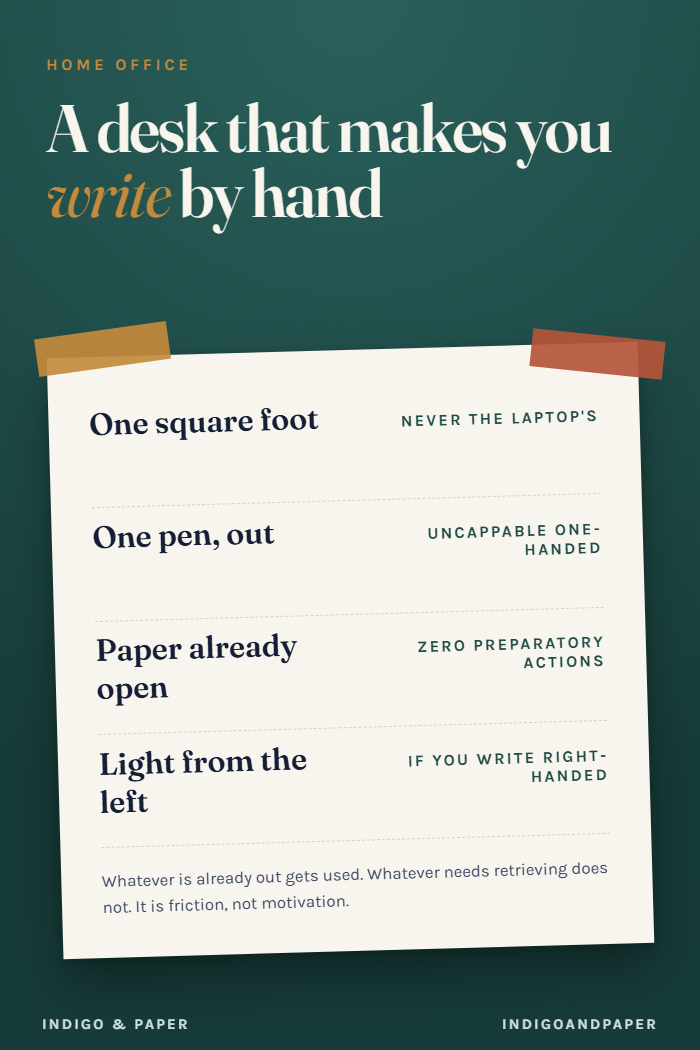
Whatever is already out gets used. Whatever needs retrieving does not.
Everything below is an application of that.
Reserve a square foot that is never the laptop's
Not a desk. A region of the desk — roughly the area of a sheet of paper plus elbow room — where the laptop is not permitted to sit, even briefly.
The reason this works is that a writing surface is not just space, it is space you do not have to clear. If writing begins with moving a computer, you will do something else. If the pad is already open at an angle you can write on, the decision is nearly free.
If your desk genuinely has no spare foot, this is the argument for a smaller laptop stand rather than a bigger desk.
One pen, out, uncapped-able with one hand
One. Not a pot of fifteen.
A pot of pens is a decision, and a small decision at the moment of starting is enough to lose the whole action. Pick the pen you actually like writing with, leave it lying across the pad, and put the rest away.
The one-handed test matters more than it sounds: if capping and uncapping needs both hands, you will not pick it up to write three words, and three words is most of what you should be writing.
Paper that is already open
A closed notebook is a container. An open one is an invitation.
Leave the pad open at the current page, blank side up. If you use a bound notebook, a ribbon or a clip at the working page does the same job. The point is that starting to write should require zero preparatory actions — no opening, no finding the page, no smoothing the spine.
For the same reason, prefer a pad that lies flat. A notebook that springs shut is one that will be shut.
Light from the side you do not write with
Right-handed writers want light from the left, and the reverse. Otherwise your hand shadows the line you are writing.
This sounds fussy and is not: writing in your own shadow is genuinely unpleasant and people who do it write less without ever identifying why. It is usually a matter of moving one lamp about thirty centimetres.
What to actually put on the paper
The desk-based case for handwriting is not journaling. It is these four, all of which are worse on a screen:
- Thinking through a decision. Slower is the feature; you cannot outrun your own reasoning at handwriting speed.
- The day's three things. Written once, in the morning, visible all day without a window being in front of it.
- Anything you want to remember. The recall advantage of handwriting over typing is one of the better-replicated findings in the area, and it costs nothing to exploit.
- Letters. For which there is a whole section here, and which are the one thing on this list where the physical object is the point rather than a side effect.
What not to buy
Almost everything. The failure mode of this topic is spending an afternoon researching desk accessories, which is itself a way of not writing.
The genuinely load-bearing items are a pen you like, paper that lies flat, and a lamp in the right place. A pen cup, a leather mat, a brass rule and a blotter are pleasant and change nothing about how often you write.
If you want to spend on something with a return, spend it on paper quality rather than on organisation. Bad paper that feathers or ghosts makes writing mildly unpleasant every single time, and mild unpleasantness is exactly the scale of force that decides whether a habit survives.