What Paper to Use With a Fountain Pen
Everyone asks about gsm. It is the wrong number — and it explains why 80gsm paper can outperform 120gsm.
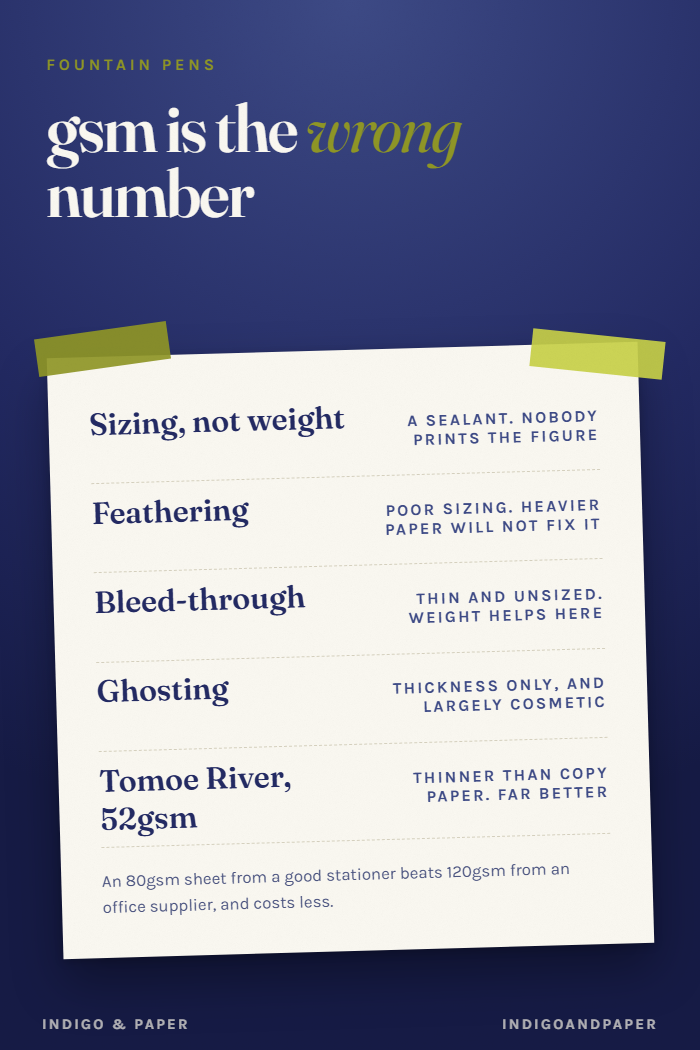
Almost every version of this question is asked in gsm. What weight paper for a fountain pen? What thickness? Is 100gsm enough?
Gsm is the wrong number. It is worth knowing why, because once you know it the whole question becomes easy and you stop buying heavy paper that behaves badly.
What gsm actually measures
Grams per square metre. It is weight, not thickness and not quality. A sheet can be heavy and absorbent or light and sealed, and the two behave completely differently under a wet nib.
This is why an 80gsm sheet from a good stationer can handle a broad nib flawlessly while 120gsm from an office supplier feathers immediately. The heavier sheet is worse, and it costs more.
The number that actually matters: sizing
Sizing is a sealant added during manufacture that stops liquid soaking into the fibres. Well-sized paper holds ink on the surface long enough to dry as a crisp line. Poorly sized paper wicks it along the fibres.
Nobody prints a sizing figure on the packet, so you cannot look it up. What you can do is recognise its three failures, because each looks different and each tells you something specific.
The three failures, and what each one means
Feathering — the line grows fuzzy tendrils along the fibres, like a watercolour edge. That is poor sizing, and it is the one that makes handwriting look bad rather than merely inconvenient. No amount of extra weight fixes it.
Bleed-through — ink appears on the reverse as actual wet marks. Usually thin and poorly sized together. This is where weight genuinely helps.
Ghosting or show-through — you can see the writing from the other side but the reverse is dry to the touch. Purely a thickness matter, and largely cosmetic. Plenty of people who write on both sides simply accept it.
So: feathering is a sizing problem, bleed-through is both, ghosting is thickness. If you only have feathering, buying heavier paper will not help.
What to actually buy
Choose by surface and reputation, not weight:
- Rhodia and Clairefontaine at 80–90gsm handle almost any nib. Their
- advantage is entirely sizing and a smooth, calendered surface.
- Tomoe River is famously about 52gsm — thinner than copy paper — and among
- the best fountain pen papers made. It ghosts heavily and barely bleeds. It is
- the clearest possible demonstration that weight is not the variable.
- Standard 80gsm copy paper is unsized for fountain pens and will feather
- with most nibs. It is fine with a ballpoint or a fineliner, which is what it
- was made for.
- Laid and heavily textured writing papers look wonderful and behave
- unpredictably: the texture that makes them attractive gives ink more edge to
- travel along.
If a shop lists paper as suitable for fountain pens, that claim is usually about sizing and is usually reliable. It is more informative than the gsm figure printed beside it.
Test it in thirty seconds
Before committing to a pad or a box of writing paper, on one sheet:
- Write a line normally.
- Write a second line slowly, so the nib lays down more ink.
- Draw a small solid block and let it sit for a few seconds.
- Turn the sheet over.
The slow line and the block are where feathering and bleeding show first. A paper that survives a deliberately over-inked block will survive anything you write on it.
Where it matters more than you would think
For a letter that gets kept, the paper is doing two jobs: taking the ink now, and surviving a house move later. Thin, poorly sized paper does neither — feathered writing reads as careless even when it was not, and lightweight sheets crease along the folds until the crease becomes a tear.
That is a small part of a larger point about which letters actually survive: five things the kept ones have in common, and none of them is good handwriting.
And if it is going in the post
Weight matters again, for a different reason — an envelope needs to survive machinery. Which paper weights actually survive the post is a separate question with a separate answer, and it is the one where heavier genuinely is better.