A Christmas Gift List That Survives December
The five columns a Christmas gift list needs, why the idea column should hold what the person said, and how to stop a bought gift being mistaken for a delivered one.
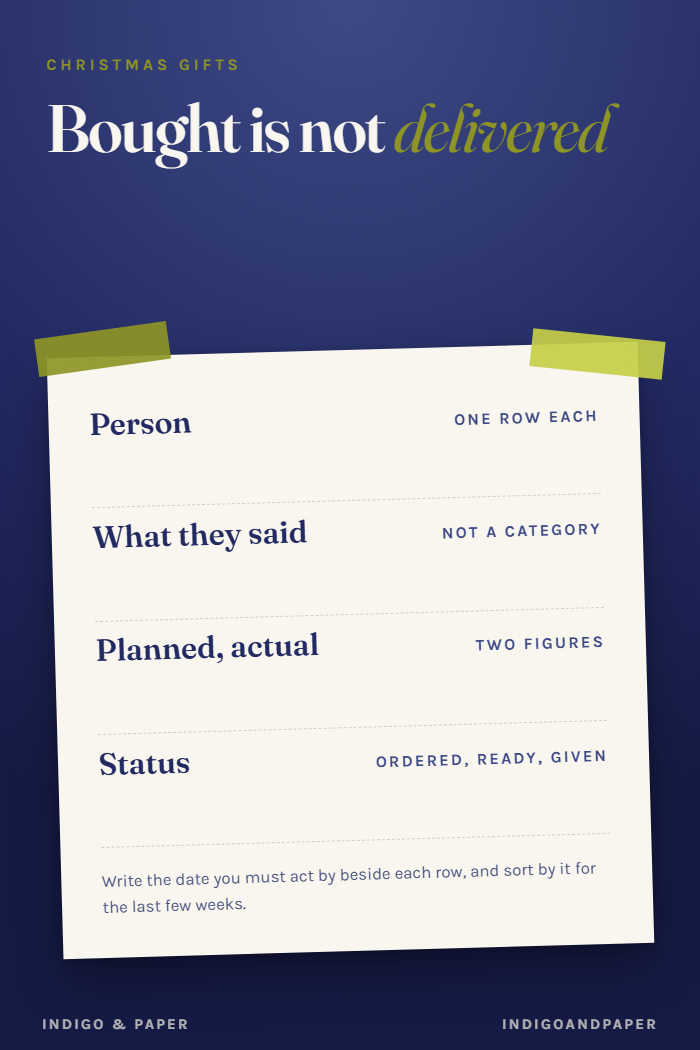
Most Christmas gift lists fail in the same two places. Early on, the list is a column of names with nothing useful next to them, because the ideas were somewhere else: a message, a conversation in July, a screenshot. Late on, the list says "done" beside a present that is still in a warehouse, because bought and delivered were never separate boxes.
A list that survives December fixes both, and it does not need to be clever to do it.
The five columns
Person. One row per person, not per gift. If one person gets two small things, they share a row. It keeps the count honest.
What they actually said. The column that makes the list worth keeping. Not "likes cooking" but "said her good knife went missing in the move". A gift that answers something the person said out loud lands differently from one chosen from a category. Write it down when you hear it, in whatever month that is, because by December you will not remember who said what.
The idea, and a spare. One idea you are going with and one fallback. The fallback is for the week something sells out, and it saves the most expensive kind of last-minute shopping.
Planned and actual. Two figures, not one. Writing only the price you meant to pay hides the drift, and the drift is how a sensible budget turns into a January surprise. Add them up yourself once a week.
Status: ordered, ready, given. Three stages, not a single tick. Ordered means paid for. Ready means it is in the house, wrapped or not. Given means it has left your hands. The gap between ordered and ready is where Christmas goes wrong, and a single "done" column cannot show it.
Work backwards from the date
For anything posted or made by hand, the useful date is not Christmas Day. It is the last day you can order or start and still have it in time. Carriers and shops publish their own cut-offs each year and they vary, so check the ones that apply to you rather than trusting a general figure. Write the date you must act by next to the row, and sort by that date rather than by name for the last few weeks.
If you are making a gift, work backwards the same way, and write down a simpler version you would accept if the time runs out. That line is what stops a handmade present becoming a sleepless one.
When several people give together
Shared gifts need one person coordinating and a written note of who has paid their share. It is the least festive part of the whole exercise and the part that most often leaves one person quietly out of pocket. A single row per shared gift, with contributions agreed and received, is enough.
Paper, a spreadsheet or an app
All three work. A spreadsheet with the five columns above does the whole job, costs nothing, and shares easily with a partner. Gift-list apps do the same job.
The argument for a sheet of paper is narrower: it keeps the list out of any device someone else might pick up in December. Gift lists are one of the few household documents that need to be private from the people they are about.
If you would rather it were already laid out
Five columns ruled on a sheet of paper do everything above, and cost nothing.
If you want the pages drawn, Thoughtfully Given is an 11-page gift-planning kit for the whole year, not only Christmas. Page 5 records what each person has said they want or want to avoid, page 6 compares ideas by time as well as cost, page 7 keeps planned, actual and still-to-pay side by side in one currency, and page 9 tracks each gift from ordered or made to ready to given. Page 8 is for gifts you are making, page 10 for gifts given together, and page 4 for dates, with a column for when to decide or start. Page 3 is a worked example of one person's year, marked as fictional.
It comes as A4 and US Letter PDFs in one download, for $2.99.