How to Price Baked Goods to Sell, With a Sourdough Loaf Worked Through
Cost the whole batch, divide by the loaves you can actually sell, then price for a margin rather than a markup. One sourdough batch, worked through in figures.
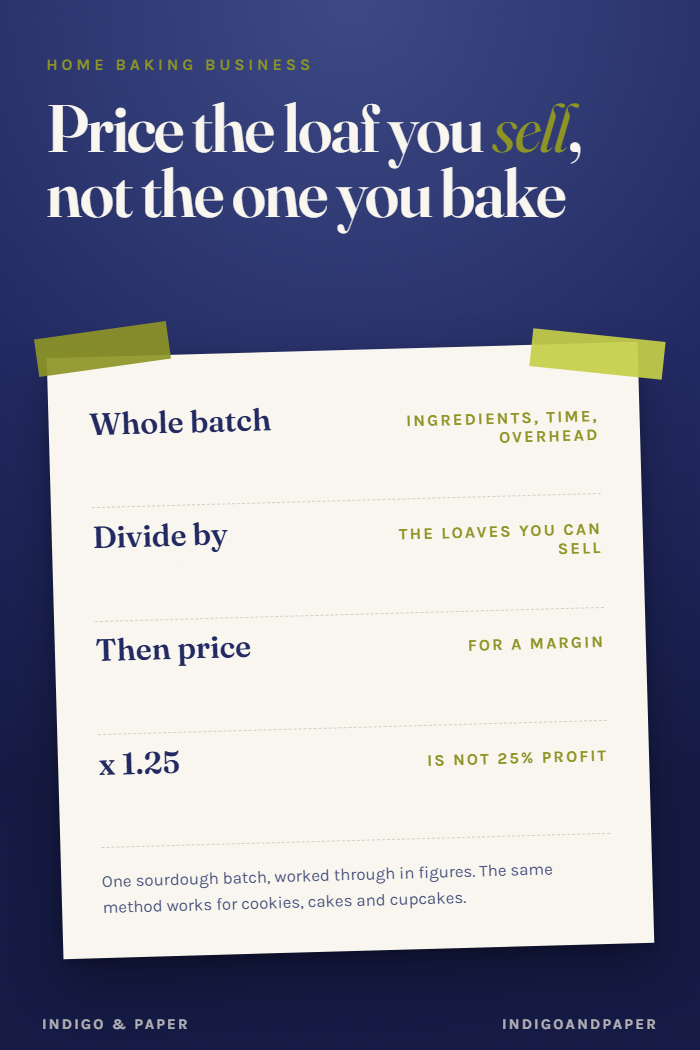
Most advice on pricing baked goods gives the same formula: add up ingredients, time and overhead, then multiply by something like 1.25 or 1.5. The idea is right. Two details in it quietly cost home bakers money, and both show up in a single batch of bread.
This page is about the arithmetic. Selling food you bake at home is regulated differently from place to place, including what you may sell, how it must be labelled and whether you need a licence. Check the rules where you live before you sell.
Cost the whole batch, not one item
A batch is what you actually make, so cost that first. Here is a fictional batch of eight sourdough loaves.
| Batch cost | |
|---|---|
| Ingredients (flour, salt, starter feeds) | 8.30 |
| Packaging (bags and labels, 8 at 0.45) | 3.60 |
| Your time: 2.5 hours of hands-on work at 20.00 an hour | 50.00 |
| Overhead (oven energy, a share of equipment and licence costs) | 4.10 |
| Whole batch | 66.00 |
Pay yourself for the time. If the price only covers ingredients, the business is you working for free, and it will stop being worth doing.
Divide by what you can sell, not what you baked
Eight loaves came out of the oven. One split badly and became tasting samples, so seven are for sale.
- 66.00 divided by 8 = 8.25 a loaf
- 66.00 divided by 7 = 9.43 a loaf
The seven loaves you sell have to carry the cost of the one you did not. Every batch has its own version of this: the cookie that broke, the cake kept back for photographs, the last loaves nobody bought. Count the ones you can sell, from your own batches, and divide by that.
Price for a margin, not a markup
A markup is added to cost. A margin is the share of the price you keep. They are not the same number, and the common formula mixes them up.
Multiplying the 9.43 cost by 1.25 gives 11.79. After a 3% card fee, that loaf keeps 2.00, which is a 17% margin, not 25%.
To keep 25% of the price after a 3% fee, work backwards from the price:
- price x (1 - 0.03 - 0.25) = cost
- price = 9.43 / 0.72 = 13.10
At 13.10 you keep a quarter of every sale after the fee and after paying yourself for your time. At a round 13.00 you keep 24.5%, which you may be happy with. The point is that you now know.
What the two mistakes cost together
Use 8.25 (ignoring the sample loaf) and multiply by 1.25, and each loaf sells for 10.31. Seven loaves bring in 72.19; the card fees take 2.17 and the batch cost 66.00. The whole batch leaves about 4.00 over your wage for a day of baking. Priced at 13.10, the same seven loaves leave about 23.
The same method for cookies, cakes and cupcakes
- Cookies and cupcakes: cost the whole batch, count the ones good enough to sell, and decide whether you price singly or by the dozen. A dozen is one unit with twelve items' costs in it.
- Celebration cakes: time dominates. Include decorating and consultation time, and any boards, boxes or supports that leave with the cake.
- Bake sales and fundraisers: the goal is different. Covering ingredients may be enough, and that is a choice, not a mistake, as long as you make it on purpose.
Check your price against the market, last
Once you know your price floor, look at what similar bakes sell for where you sell. If your floor is above the local going rate, the answer is to change the product, the batch size or the time it takes, not to sell below cost.
If you want this laid out as a spreadsheet
Paper works, once you have costed and timed a batch.
The Maker's Pricing Workbook is a spreadsheet laid out in this order. Its Batch costs tab has rows for ingredients, packaging, your time and overhead, divided by the items you can actually sell. Its Price tab takes fees, shipping, discounts and your own target margin, and a status line flags when your price misses it. It was built for makers of all kinds, not only bakers, and it has been opened and recalculated in Microsoft Excel for Windows. It does not know food rules, fee schedules or what you should charge; the figures are yours.