What to Write in a Letter
The blank page is not a shortage of things to say. It is the wrong question — and there is a better one that takes about four seconds to answer.
You have the paper, you have the pen, and you have been sitting there long enough to notice you are sitting there.
The freeze is almost never a shortage of things to say. It comes from the question you are asking yourself, which is what should a letter contain — and that question has no answer, because a letter is not a form with fields.
Ask a different one.
The question that unsticks it
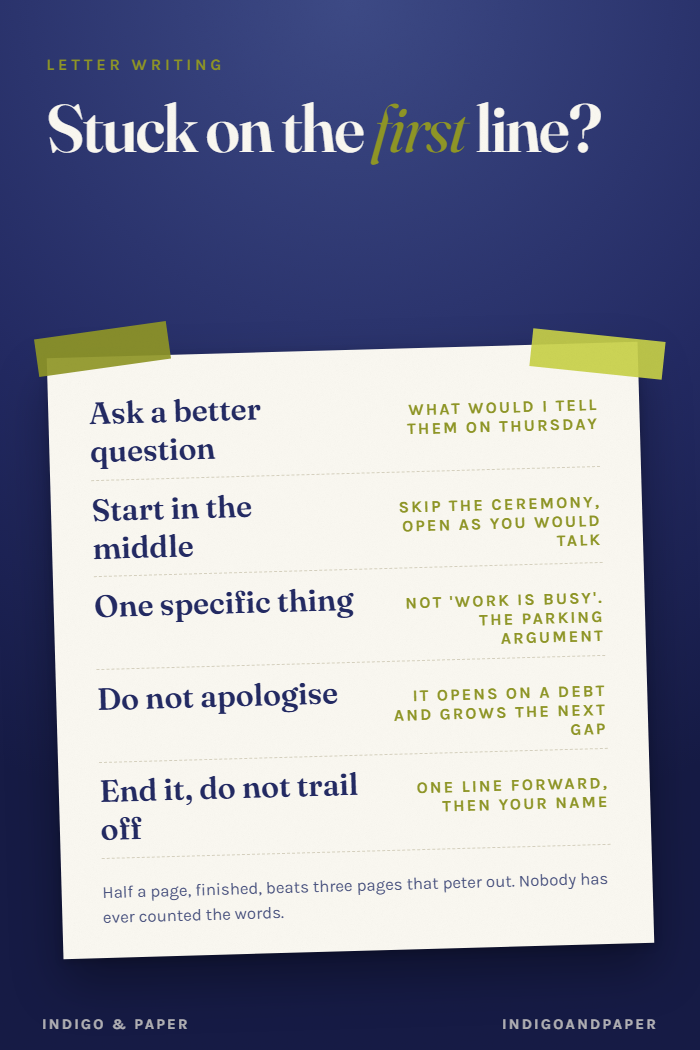
What is the one thing I would tell them if I saw them on Thursday?
Not the summary of your year. Not the news. The one specific thing you would actually mention if they were standing there.
Then write that, and keep writing until it is finished. Almost always, that is the letter — and it is a better letter than the four paragraphs of update you were about to attempt, because it is the only part either of you will remember.
Start in the middle
The hardest sentence in any letter is the first one, and it is hardest because people try to make it do ceremony. I hope this finds you well. It has been so long. I have been meaning to write.
Skip all of it. Open where you would open if you were talking:
There is a bakery on the corner now where the hardware shop was. I have been thinking about what you said about your brother. It snowed here, properly, for the first time in years.
Nobody has ever put a letter down because it started too abruptly. Plenty have been put down after the third line of preamble.
Four things that always work
Not a template — four reliable places to look when you genuinely cannot think of anything.
Something small and specific from this week. Not "work is busy". The particular thing: the argument about the parking space, the exact biscuit you have been eating too many of. Specificity is what makes a letter feel like a person rather than an update.
Something you noticed about them. A thing they said that stayed with you, a way they handled something. People receive very little of this and remember almost all of it.
A question you actually want answered. One, not five. Five reads as an interview and gets none of them answered.
Something you would not say aloud. Slowness gives permission — you can write the sentence that would be too much across a table, because they get to read it privately and answer in a week. This is the thing letters can do that a message cannot, and it is why they get kept.
Do not apologise for the gap
Sorry it has been so long, I'm terrible at keeping in touch.
Everybody writes it and it costs more than it seems. It opens on a small debt, it invites the reader to feel owed something, and it makes the next letter harder to start because now there is a bigger gap to apologise for. That is how people stop writing entirely.
The gap does not need addressing. If you must, one line, no self-criticism: I have been meaning to write for months and here it finally is.
Finish it, do not just stop
Most letters trail off, because the writer runs out of things and puts the pen down. A letter that stops feels unfinished; one that ends feels deliberate, even if it ends after half a page.
Ending is one sentence that looks forward or lands the point:
Write back and tell me about the house. I think about that summer more than I expected to.
Then your name. That is sufficient.
On length, since everyone worries about it
Half a page, finished, beats three pages that peter out. Length is not the measure of care and no recipient has ever counted the words.
The letters people keep tend to be short, specific, and about one thing.
---
The five properties the kept ones share are set out here — and none of them is good handwriting. If you are worried about yours, that is the reassuring part.
For the practical end of it — where the address goes, and which paper survives the post — the addressing grid and envelope templates are $12.